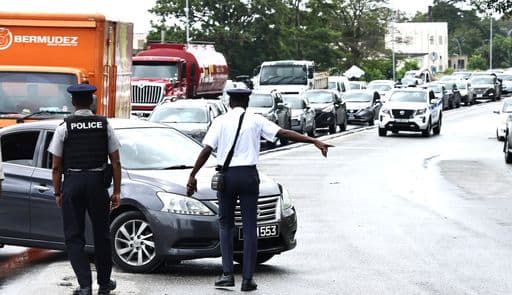
On July 10, 2025, Transport Minister Eli Zakour signed an order deleting demerit points for 63 of 69 traffic offences. Six remained: driving under the influence, driving while disqualified, careless driving, dangerous driving, refusing to provide a specimen, and a handful of related charges. The government did not hold public consultations before the order was signed. It did not publish a policy paper explaining why 63 offences no longer warranted the behavioural consequence that demerit systems are designed to provide. The order was signed. The points were gone.
Five months later, on Christmas Day 2025, Legal Notice No. 471 doubled the fixed penalties for more than 60 traffic offences. Speeding fines rose to a range of $2,000 to $6,000. Using a mobile phone while driving went from $1,000 to $2,000. Driving without insurance jumped from $1,000 to $10,000 - a 900 percent increase. Pedestrian crossing violations doubled to $4,000. Driving under the influence penalties reached $24,000 for a first offence and $45,000 for a second. Again, no public consultation preceded the notice.
These two decisions - the gutting of the demerit system in July and the doubling of fines in December - represent a contradiction so direct that it demands explanation. Demerit points exist to change driver behaviour through accumulated consequences. Fines exist to punish individual violations. A government that was serious about road safety would strengthen both. A government that removed one and doubled the other has made a choice, and that choice tells you something about what the policy is actually for.
What Demerit Points Were Supposed to Do
The demerit point system was introduced in Trinidad and Tobago as part of the Motor Vehicles and Road Traffic Act amendments. The idea is simple: each traffic offence carries a point value, points accumulate on the driver's licence, and when the total hits a threshold, the driver faces suspension, mandatory retraining, or revocation. The system creates a behavioural incentive that fines alone cannot. A wealthy driver can absorb a $2,000 fine without changing anything. That same driver cannot absorb the loss of a licence.
Demerit systems work because they are cumulative. A single speeding ticket might not change how someone drives. But knowing that a second or third offence moves you closer to losing your licence does. This is why the United Kingdom, Australia, Canada, Germany, and Japan all use demerit points. Jamaica maintains its system. Barbados has been developing one.
Trinidad and Tobago is now the only country in the Caribbean that had a functioning demerit system and chose to dismantle it. The government has not identified another jurisdiction that made this choice. It has not cited any study or expert recommendation supporting the removal of demerits for 91 percent of traffic offences. The decision exists in a policy vacuum.
What Doubling Fines Actually Does
Fines are a one-time penalty. They punish a specific violation at the moment of enforcement. For fines to actually deter behaviour, the fine has to be large enough to matter and the probability of being caught has to be high enough that the fine feels like a real risk rather than bad luck.
Trinidad and Tobago's traffic enforcement infrastructure has not changed between July and December 2025. The number of traffic officers did not double. Automated enforcement - speed cameras, red-light cameras - was not expanded. The probability of being caught committing a traffic offence on any given trip remained roughly the same. What changed was the price of getting caught.
The government's position is that higher fines will deter dangerous driving. Prime Minister Persad-Bissessar, defending the increases in late December, stated: "If you don't want to get hang in the gallows, you don't commit murder." That analogy tells you how the government sees traffic enforcement - as punishment, not prevention. The logic is deterrence through severity, not deterrence through system design.
The problem is that decades of criminological research point the other direction. Certainty of punishment deters more effectively than severity. A $1,000 fine with a 40 percent chance of enforcement deters more than a $6,000 fine with a 5 percent chance. Without increased enforcement capacity, doubling fines mostly just increases the cost for the drivers who do get caught, while the behaviour of the majority stays the same. It also raises more revenue per ticket issued.
The PM's Own Words
In August 2024, while in opposition, Persad-Bissessar described existing traffic fines as "excessively high" and characterised the penalty structure as "revenue collection" rather than road safety. She was speaking to an audience of drivers who felt the financial burden of the existing fine schedule.
By December 2025, the same prime minister was defending fines 100 percent higher than the ones she had called excessive. The rhetorical shift required only sixteen months. The policy shift required no public consultation and no published rationale. There was no acknowledgment that the position had reversed.
This is not a minor inconsistency. When a political leader calls fines excessive as a campaign talking point and then doubles them in office, it undermines the credibility of both positions. Were the original fines genuinely too high, or was the objection politically convenient? Are the new fines genuinely necessary for safety, or are they serving precisely the revenue function that the PM once criticised?
The Revenue Question
Trinidad and Tobago does not publish disaggregated data on traffic fine revenue. The Ministry of Finance does not separately report how much the state collects annually from fixed penalties under the Motor Vehicles and Road Traffic Act. This gap in public financial reporting makes it impossible to calculate precisely how much additional revenue the December increases will generate.
What can be estimated is the direction. If enforcement rates remain constant and the number of violations detected stays roughly the same, doubling the fine schedule doubles the revenue from those violations. The government has not earmarked the additional revenue for road safety improvements or enforcement technology. It flows into general revenue. For a government managing a tight fiscal position with oil prices below the budget peg, additional revenue from any source has practical value.
None of this proves that the fine increases were motivated by revenue rather than safety. It does mean that the revenue explanation is consistent with the evidence, while the safety explanation has a gap - the simultaneous removal of the demerit system that would have made the safety case coherent.
The Fixed Penalty Warning System
Public backlash to the fine increases was immediate. In response, the government brought the Fixed Penalty Warning System to Parliament on January 16, 2026. It passed 27-11. The system created a warning category for 18 minor vehicle defects - bald tyres, broken tail lights, expired registration stickers - allowing officers to issue a warning and a period to remedy the defect rather than an immediate fine.
The warning system is a reasonable provision for minor, correctable defects. It is also a concession that the government's own fine schedule was producing outcomes it could not defend politically. The 18 offences covered by the warning system are a small fraction of the 60-plus offences that saw doubled fines. The major penalties - speeding, mobile phone use, DUI, insurance violations - remain doubled with no demerit consequences attached to most of them.
Road Fatalities: The Data That Preceded Both Decisions
Road fatalities in Trinidad and Tobago declined approximately 12 percent in 2025, from 124 deaths in 2024 to 109. That is a meaningful reduction. It is also a reduction that occurred mostly before either the demerit removal or the fine increases took effect. The July demerit order and the December fine notice both postdate the period in which the improvement was recorded.
This timing matters because the government has pointed to the fatality data to justify its approach. But if road deaths were already declining before either policy change took effect, neither the demerit gutting nor the fine doubling can claim credit. SoE-related police presence, fuel price changes affecting how much people drove, or plain statistical variation may explain the decline more plausibly than policies that were not yet in place.
What Coherent Road Safety Policy Looks Like
A government that was serious about reducing road deaths would keep the demerit system and strengthen it, because cumulative consequences change habitual behaviour in ways that one-off fines cannot. It would invest in speed cameras and red-light cameras, because certainty of detection matters more than the size of the fine. It would fund driver education. And it would publish enforcement data so Trinbagonians could evaluate whether any of it was working.
The Persad-Bissessar government did none of this. It removed the cumulative consequence system, left enforcement capacity unchanged, skipped automated detection entirely, and doubled the monetary penalty for getting caught. No public consultation. No published road safety strategy. No reconciliation with the PM's own prior statements about fines being excessive.
A demerit system without fines is toothless. Fines without a demerit system are transactional - pay the price, keep driving, change nothing. Trinidad and Tobago now has the second arrangement. Whether that amounts to road safety or revenue collection depends on which half of the government's own record you look at. The Promise Tracker will continue to measure what was committed against what was delivered. The manifesto examination checks the broader pattern of populist wins versus structural gaps. The one-year review provides the full scorecard. On road safety, the commitment was to reduce fines. The delivery was to double them.
Sources
- Legal Supplement, Trinidad and Tobago Gazette: Order by Transport Minister Eli Zakour, July 10, 2025 (deletion of demerit points for 63 of 69 offences)
- Legal Notice No. 471 of 2025: Motor Vehicles and Road Traffic (Fixed Penalty) (Amendment) Order, December 25, 2025
- Parliament of Trinidad and Tobago: Hansard, Fixed Penalty Warning System debate and vote (27-11), January 16, 2026
- Trinidad Express: "Fines doubled for over 60 traffic offences" (December 2025)
- Trinidad Guardian: "PM defends fine increases: 'If you don't want to get hang in the gallows'" (December 2025)
- Newsday: "Opposition leader had called fines 'excessively high' and 'revenue collection'" (August 2024 campaign coverage)
- Trinidad Express: "Road fatalities drop 12% in 2025 - 109 vs 124" (January 2026)
- Newsday: "Fixed Penalty Warning System passes 27-11" (January 2026)
- Jamaica Road Traffic Act: Demerit point provisions (current)
- Barbados Road Traffic (Amendment) Bill: Demerit system introduction (in development)
- Trinidad Guardian: "No public consultation on demerit point removal or fine increases" (2025)
- Ministry of Works and Transport: Motor Vehicles and Road Traffic Act, demerit point schedule (pre-July 2025)