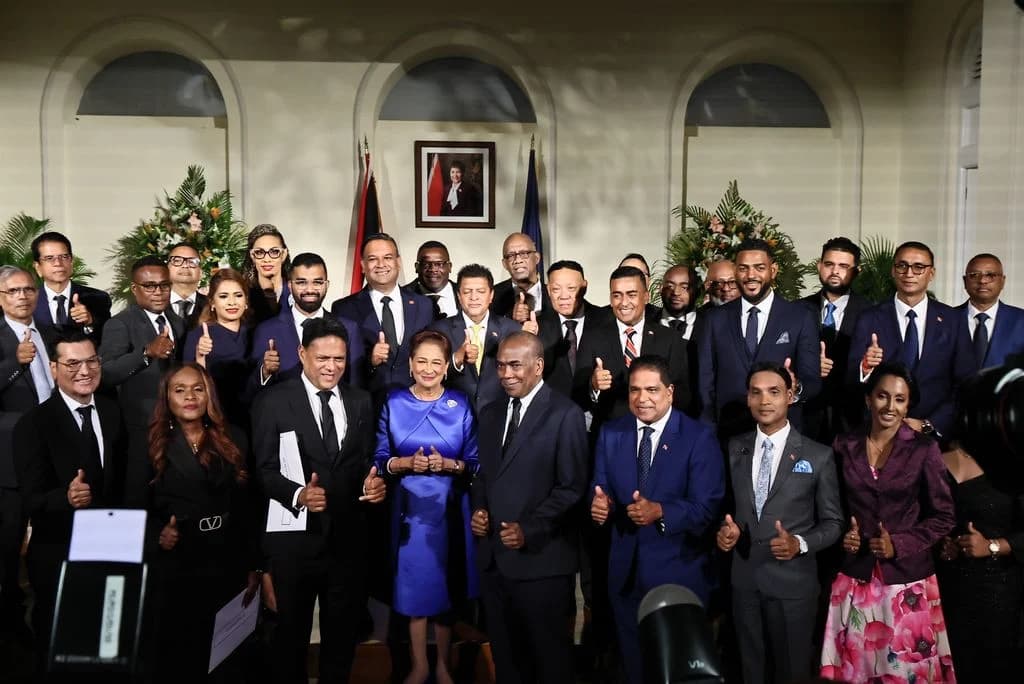
When Prime Minister Kamla Persad-Bissessar announced her Cabinet following the April 2025 general election, it was the largest executive formation in the history of Trinidad and Tobago. Approximately 25 to 26 full Cabinet ministers, five to six ministers of government (junior ministers), and six to seven parliamentary secretaries - a total of roughly 38 to 39 officeholders drawing ministerial salaries, vehicle allowances, staff budgets, and office expenses from the public purse.
For a country of 1.4 million people, that is one minister for every 37,000 citizens. By comparison, Keith Rowley's final PNM cabinet had 22 members. The current formation is 40 to 50 percent larger.
This article is not an argument that smaller is inherently better. There are legitimate reasons to expand a cabinet - new policy priorities, devolved authority, the inclusion of coalition partners. But size carries cost, and composition tells you something about priorities.
The Split Ministries
The most obvious driver of the expansion was the decision to split several existing ministries into two or more separate portfolios.
National Security was divided into Defence and Homeland Security. The Ministry of Works was split into Works and Transport. The Attorney General's office was separated into the Attorney General, the Ministry of Justice, and Legal Affairs. Each split created a new minister, a new permanent secretary's office, new administrative staff, new vehicle fleets, and new overhead.
Whether these splits improve governance depends on execution. A dedicated Ministry of Transport could, in theory, bring focused attention to PTSC, the water taxi, and the inter-island ferry - services that have languished under broader portfolios for years. A separated Justice Ministry could prioritise court modernisation and case backlogs independently of the AG's litigation workload. The logic is not unreasonable.
But the logic has to produce results, and the cost has to be justified. None of the newly split ministries has published a strategic plan explaining what the separation enables that the combined portfolio could not. The government has not disclosed the incremental cost of the additional ministerial offices, staff, and infrastructure. Trinbagonians are paying for the split. They have not been told how much.
Then there is the Ministry of Public Administration and Artificial Intelligence. As far as publicly available records indicate, it is the only ministry in the Commonwealth Caribbean with "AI" in its name. Whether this reflects genuine policy ambition or branding is an open question. The ministry's mandate, staffing plan, and budget allocation have not been detailed publicly.
The Gender Question
Of the approximately 38 officeholders in the Cabinet, seven are women. That is roughly 18 to 20 percent.
Trinidad and Tobago has no legal requirement for gender parity in cabinet appointments. Neither the PNM nor the UNC has ever committed to specific gender targets. But in a country where women make up the majority of university graduates and a significant share of the professional workforce, an 18 percent representation rate in the executive raises questions about how talent is selected.
The UNC's 2025 manifesto did not include a gender parity commitment for cabinet formation. The party's internal selection process for candidates and ministerial appointments has not been made public. The result is a cabinet where roughly four out of every five decision-makers are men.
For context: Rwanda's cabinet is 52 percent women. Canada's is 50 percent. South Africa's is 47 percent. These are countries with explicit parity mandates or strong political conventions around gender balance. Trinidad and Tobago has neither, and the current formation reflects that absence.
Nobody is arguing that ministers should be appointed on the basis of gender rather than competence. But a talent pool as deep as Trinidad and Tobago's should be producing more than seven women out of 38 senior appointments.
The Ethnic Composition
This is a topic most Trinbagonian commentators avoid in print. It should not be avoided.
The Cabinet's ethnic composition skews approximately 60 to 65 percent toward individuals of Indian descent, with the remainder drawn from Afro-Trinbagonian, mixed, and other backgrounds. The national population splits roughly 35 percent Indian-descent, 34 percent African-descent, and the remainder mixed or other ethnic groups.
Every government in Trinidad and Tobago's history has drawn its cabinet disproportionately from its electoral base. The PNM's cabinets skewed Afro-Trinbagonian. The UNC's skew Indian-Trinbagonian. This is not unique to either party. It is a structural feature of a political system where voting patterns correlate strongly with ethnicity and where party loyalty follows community lines.
The problem is not that any individual minister is the wrong ethnicity. The problem is that a cabinet meant to govern all Trinbagonians consistently fails - under both parties - to look like the country it serves. When one-third of the population sees itself reflected in two-thirds of the executive, and another third sees itself reflected in far less, the composition sends a message about whose interests sit closest to power.
Neither party has proposed reforms to address this. No cross-party appointment conventions, no independent selection panels, nothing in the constitution requiring demographic balance. The pattern repeats with each election because neither side has an incentive to change it.
Three Ministers, Three Legal Questions
At least three members of the current Cabinet carry active or recent legal issues that would, in many parliamentary systems, have triggered questions about their suitability for ministerial appointment.
David Lee, Housing Minister and UNC Deputy Political Leader, was re-arrested on fraud charges in October 2025 while serving in office - conspiracy to defraud the State and misbehaviour in public office related to the importation of a Mercedes-Benz AMG G63 valued at TT$2.34 million. He refused to resign. The PM said she had "confidence in the courts."
Roodal Moonilal, Energy Minister, faces a $275 million civil cartel lawsuit (the EMBD case) involving alleged bid-rigging and bribery on road rehabilitation contracts during the UNC's 2010-2015 term. The trial is set for June 2026 before Justice Seepersad. He was appointed to Cabinet despite the pending litigation.
Anil Roberts, Minister in the Ministry of Housing, returned to government despite presiding over the $349.5 million LifeSport fraud as Sport Minister from 2010 to 2014. A Central Audit Committee found ghost participants, ghost centres, and criminal infiltration. Roberts resigned in 2014 but was never charged. The police investigation has never been submitted to the DPP despite more than 11 years of work.
None of these individuals has been convicted of any offence. That distinction matters. But the question is not whether they are legally guilty. The question is whether a Prime Minister assembling the largest cabinet in the country's history could not find alternatives who did not carry these particular complications. The talent pool of UNC parliamentarians and senators is not so shallow that these were the only options.
The standard in parliamentary governance has never been whether a minister has been convicted. It is whether a minister's circumstances create a perception problem that distracts from governance. The Prime Minister's decision to appoint all three suggests either that she judged the perception acceptable, or that internal party dynamics required their inclusion.
The Cost Nobody Has Published
Every ministerial appointment carries direct and indirect costs. Direct costs include the minister's salary, allowances, official vehicle, driver, security detail, and personal staff. Indirect costs include the permanent secretary, administrative staff, office space, and operational budget for each ministry.
For a cabinet of 22, these costs are significant. For a cabinet of 38, they are substantially larger. The government has not published a consolidated figure for the total cost of the expanded executive.
This is not a minor omission. The difference between 22 and 38 ministerial offices is not just 16 additional salaries. It is 16 additional sets of staff, vehicles, offices, travel budgets, and administrative overhead - recurring annually for the duration of the government's term. If each additional ministerial office costs, conservatively, $3 million to $5 million per year in loaded expenses, the expansion adds $48 million to $80 million annually.
The government has justified neither the number nor the expense.
Does 1.4 Million People Need 38 Ministers?
It is a real question, not a rhetorical one. Some countries with larger populations run smaller cabinets. Others with similar populations use fewer ministers but give more authority to permanent secretaries. What the right size looks like depends on the country's administrative needs and the capacity of its public service.
Trinidad and Tobago has 14 municipal corporations, a semi-autonomous Tobago House of Assembly, a relatively small geography, and a public service that has historically struggled with coordination across ministries. Whether adding more ministers improves coordination or simply adds more nodes to an already tangled network is a question the government has not addressed.
The Promise Tracker monitors whether the expanded cabinet is delivering on the government's commitments. The Union Conflict analysis examines the relationship between cabinet members and the interest groups they formerly represented. Together, they provide a framework for assessing whether the largest cabinet in the country's history is also the most effective - or just the most expensive.
The answer, eleven months in, is that it is too early to tell on effectiveness and too late to pretend the cost does not matter. Thirty-eight ministers for 1.4 million people is a choice. It should be explained and justified, not simply accepted as the way things are done.
Sources
- Office of the Prime Minister: Cabinet Appointment Announcements (May-June 2025)
- Trinidad Guardian: "PM names largest Cabinet in T&T history" (2025)
- Trinidad Guardian: "Cabinet gender composition analysis" (2025)
- Trinidad Express: "New ministries created as Cabinet expands" (2025)
- Trinidad Express: "Ministry of Public Administration and AI established" (2025)
- Newsday: "Lee faces active fraud charges" (2025)
- Trinidad Guardian: "EMBD spending: $275M under scrutiny" (historical)
- Trinidad Express: "LifeSport programme - $349.5M in spending investigated" (historical)
- CSO: Trinidad and Tobago Population and Housing Census data
- Parliament of Trinidad and Tobago: Cabinet composition records (2015-2025)
- PNM Cabinet formation records (2020-2025)
- UNC Manifesto 2025: uncmanifesto.com