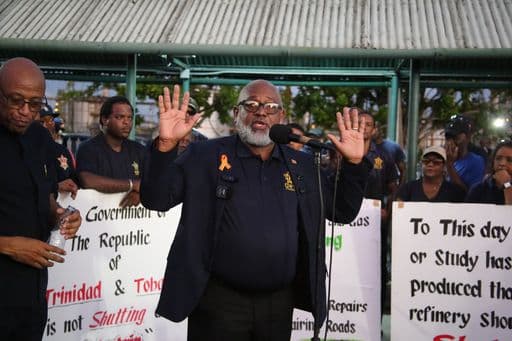
When the UNC formed its government after the April 2025 general election, three trade union leaders crossed from the picket line to the cabinet table. Ernesto Kesar of the Oilfields Workers' Trade Union became Minister in the Ministry of Energy. Leroy Baptiste of the Public Services Association became Minister of Labour. Clyde Elder of the Communication Workers' Union became Minister in the Ministry of Public Utilities.
Union leaders entering government is not new in Trinidad and Tobago, and it is not inherently wrong. But what happens when those officials are assigned to oversee the sectors, companies, and contracts they were negotiating with or litigating against months earlier? Does the institutional framework do anything to manage the resulting conflicts?
In all three cases, no.
Kesar: From OWTU Trustee to Energy Ministry
Ernesto Kesar won Point Fortin for the UNC in April 2025 - a seat the PNM had held since 1986. He ran as part of the OWTU-UNC alliance, one of two union candidates fielded alongside the party. His appointment to the Ministry of Energy placed him inside the ministry that oversees the Guaracara refinery restart, the single largest energy policy question facing the government.
The OWTU has been pursuing control of the Guaracara refinery since its closure in 2018. Through its corporate vehicle Patriotic Energies and Technologies, the union mounted three failed bids between 2019 and 2021. Those bids generated roughly $40 million in debt, including loans from KCL Capital Market Brokers. In June 2025, Justice Carol Gobin ruled that the OWTU and Patriotic Energies were jointly liable for over US$4.3 million in unpaid KCL loans. The judgment names Kesar.
This is not a peripheral connection. Kesar personally signed KCL loan agreements as an OWTU trustee in 2019 and 2020. Those loans financed the OWTU's refinery acquisition attempts. The High Court found the OWTU and its entities liable. The minister now evaluating refinery policy is one of the people who signed the loan documents that funded the OWTU's bid for that same refinery.
The OWTU has since created a new entity - Patriotic Energies Services, or PES - to pursue the refinery through a different corporate structure. PES signed the US$50 million Tecnimont deal announced in March 2026. The Energy Ministry website, as of publication, states that Kesar "currently serves" as OWTU Executive Vice-President. There is no public evidence that Kesar has recused himself from any refinery-related decisions. No recusal protocol has been published. No disclosure statement exists. Nobody in government has acknowledged that this arrangement raises a conflict.
OWTU president Ancel Roget has been candid about the arrangement. He told reporters that ministers are "working with the OWTU both behind and in front of the scenes." Whether Roget intended that as reassurance or transparency, it reads as confirmation that the boundary between the union's commercial interests and the government's regulatory authority has dissolved.
Baptiste: From PSA President to Labour Minister
Leroy Baptiste's move from PSA president to Minister of Labour is a different kind of conflict - not commercial but structural.
The PSA publicly supported the UNC during the April 2025 campaign. After the election, the UNC government negotiated a wage settlement with the PSA that delivered a 10 percent increase. Other public sector unions - representing police officers, firefighters, teachers, and prison officers - settled for four to five percent. The gap is significant. Officers who put on body armour for a living received less than half the percentage increase awarded to the union whose president now sits in cabinet.
Baptiste has been direct about the disparity. When challenged, he told reporters: "Trade unions have to live with the consequences of their actions or inaction." Unions that backed the winning side got more. Unions that did not got less. The minister responsible for labour policy sees nothing wrong with this.
Assistant Superintendent of Police Anand Doodnath Pitt described the wage gap as "a betrayal of your roots" - a labour leader who spent his career advocating for workers' collective interests, now presiding over a system that rewards political alignment over occupational risk.
Baptiste may well be a competent Labour Minister. But the person setting the framework for public sector wage negotiations is the former president of the union that received the most favourable settlement. Every other union walking into the Ministry of Labour knows the minister's former organisation got 10 percent while they got four. That knowledge colours every negotiation that follows, regardless of how fairly Baptiste intends to conduct them.
Elder: From CWU to the Ministry That Oversees TSTT
Clyde Elder won La Brea for the UNC in April 2025 - another seat the PNM had held for decades. He was appointed Minister in the Ministry of Public Utilities, which oversees the Telecommunications Services of Trinidad and Tobago, commonly known as TSTT.
Elder, as CWU secretary general, had a combative relationship with TSTT. The CWU sued TSTT and won a judgment that included TT$100,000 in exemplary damages - an award courts issue not to compensate but to punish. Elder's union took a state company to court, won a punitive judgment against it, and then Elder was placed in the ministry that oversees that same company.
The CWU itself expressed "disappointment" with certain policy directions under the new government. Elder, meanwhile, described CEPEP workers affected by restructuring as "collateral damage" - language that drew criticism from labour advocates who noted the dissonance between a union leader's vocabulary and a minister's obligations.
The pattern is the same in all three cases. A union leader with active ties - financial, legal, institutional - to entities within a sector gets placed in the ministry that regulates that sector. No recusal mechanism kicks in. No conflict is formally declared.
The Institutional Gap
The Integrity in Public Life Act does not contain a recusal mechanism. Nothing in the law requires a minister to step aside from decisions involving entities they have prior financial or legal relationships with. The Act requires asset declarations, but declarations are not constraints. Knowing that a minister has a conflict is meaningless if the system provides no way to manage it.
This gap is not unique to the current government. Every administration has benefited from the Act's lack of specificity. But three union leaders in three ministries overseeing their former sectors simultaneously tests the framework more visibly than previous arrangements.
There is a precedent worth noting. When the People's Partnership won in 2010, OWTU stalwart Errol McLeod was appointed Minister of Labour. He served from 2010 to 2015. He was not placed in the Ministry of Energy. McLeod's portfolio kept him adjacent to labour policy broadly, not to the OWTU's specific commercial interests in the energy sector. Whether that separation was deliberate or incidental, it maintained a clearer boundary than what exists today.
Kesar's appointment breaks that precedent. He is not in a tangential ministry. He is in the ministry that evaluates the very refinery contracts his union has been pursuing for seven years - contracts financed by loans he personally signed.
The Question That Should Be Asked
Kesar, Baptiste, and Elder may each be conducting their duties with complete integrity. But the system does not require them to demonstrate it, and the public has no way to verify it.
Has Kesar recused himself from refinery-related decisions in the Energy Ministry? If so, that recusal should be a matter of public record. If not, someone should explain why a minister who signed loan documents for a refinery bid is now overseeing refinery policy.
Has Baptiste implemented safeguards to ensure future wage negotiations are not shaped by the PSA's political alignment? If the two-tier settlement is simply the new normal - unions that support the government get more, unions that did not get less - the government should say so plainly.
Has Elder disclosed his prior litigation against TSTT? If the ministry sees no conflict in a former adversarial litigant overseeing the entity he sued, it should explain why.
The Integrity in Public Life Act needs recusal provisions. It needs mandatory conflict-of-interest declarations that are published, not just filed. And it needs an enforcement body that operates independently of whichever government is in power. The Integrity Commission - zero prosecutions in 37 years - is not that body.
These governance challenges are structural, not partisan. The PNM made its own appointments that raised conflict-of-interest questions. The UNC is now doing the same. The difference is degree. Three union leaders in three ministries overseeing their former sectors, with one sitting on a High Court judgment related to the policy file on his desk, is a concentration of unmanaged conflicts that any governance framework should address.
Whether these ministers are honest is not really the point. What matters is whether the system is built to ensure honesty, or whether it simply trusts whoever holds power and hopes for the best. Under every government Trinidad and Tobago has had, the answer has been the same. The system trusts. The public hopes. And the safeguards that should make trust unnecessary have never been built.
Sources
- Trinidad Guardian: "History made in Point Fortin, La Brea as trade unionists win" (April 2025)
- Newsday: "Labour holds the reins of power in La Brea, Point Fortin" (April 2025)
- Trinidad Express: "Kesar appointed Minister in Ministry of Energy" (May 2025)
- Ministry of Energy and Energy Industries: Minister profiles (energy.gov.tt, accessed March 2026)
- Trinidad Guardian: "Judge rules OWTU liable for US$4M loan to help with refinery bid" (June 2025)
- Newsday: "High Court orders OWTU, Patriotic Energies to repay millions in loans" (July 2025)
- MAIRE Group: Press release - Tecnimont awarded US$50M rehabilitation study contract (March 2026)
- CNC3: "Patriotic backs US$50m refinery study" (March 2026)
- CNC3: "OWTU: New company taking helm in Guaracara Refinery push" (March 2026)
- Trinidad Guardian: "Roget: Ministers working with OWTU behind and in front of the scenes" (2025)
- Trinidad Guardian: "CPO, PSA agree to 10% wage hike" (November 2025)
- Trinidad Guardian: "Other unions seek Govt engagement following PSA's wage hike" (2025)
- Trinidad Express: "Baptiste: Trade unions have to live with the consequences" (December 2025)
- Newsday: "ASP Pitt: Wage gap a betrayal of your roots" (December 2025)
- Trinidad Express: "CWU wins exemplary damages against TSTT" (2024)
- CNC3: "CWU expresses disappointment with government policy" (2025)
- Trinidad Express: "Elder calls CEPEP workers collateral damage" (2025)
- Integrity in Public Life Act, Chapter 22:01 - Laws of Trinidad and Tobago
- Integrity Commission of Trinidad and Tobago: Annual Reports
- Parliament of Trinidad and Tobago: Hansard records