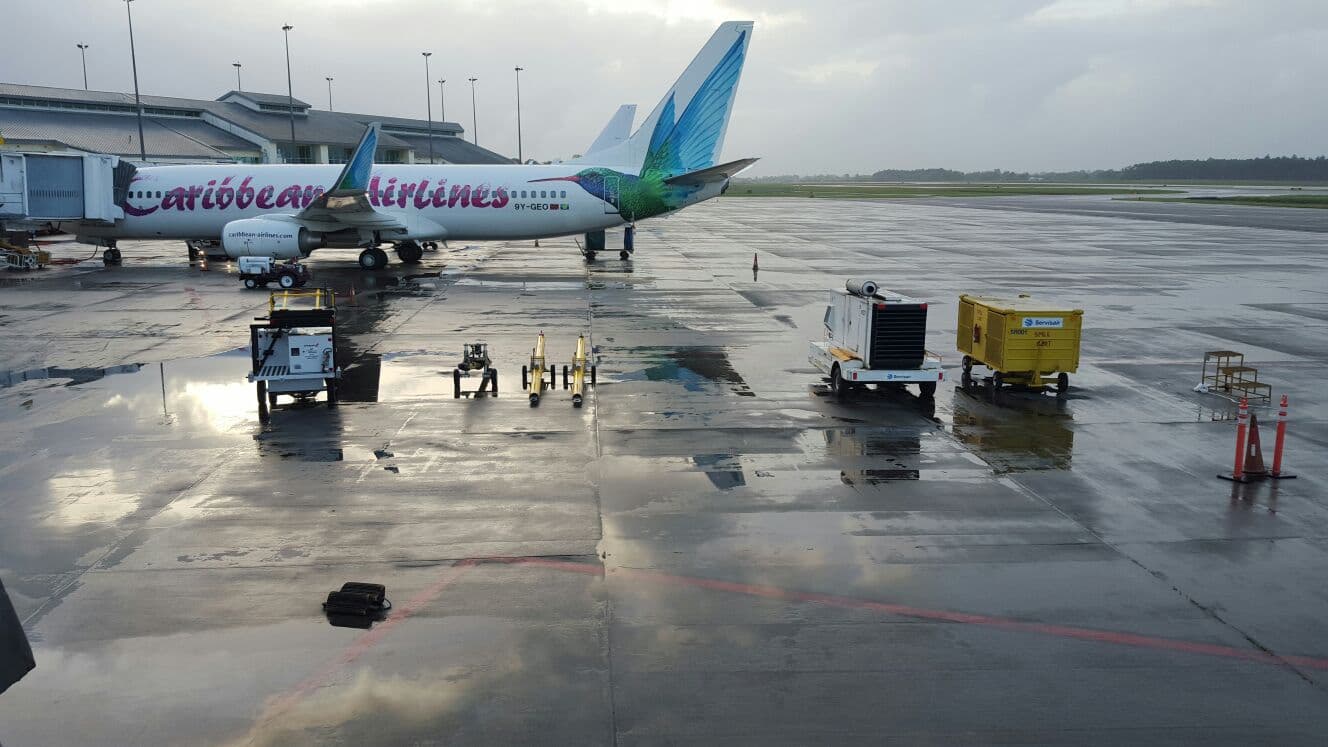
The 2026 national budget allocated $626.84 million for Caribbean Airlines loan principal repayment - more than triple the $200.8 million allocated in 2025. It also includes $70 million for the CAL airbridge subsidy, the service connecting Trinidad and Tobago across the strait. These are large numbers for an airline that has not published audited financial statements in over eight years, that has accumulated a deficit of $2.175 billion, and whose own Prime Minister has said: "not one single Caribbean Airlines route is profitable, not one route is profitable, yet plane filling out every day, going and coming."
In March 2026, CAL's board presented the Ministry of Finance with a new request: another bailout, this time driven by rising fuel costs linked to global conflict. The options on the table include a fuel surcharge on tickets, removal of the airbridge subsidy, fare increases, route cuts, and - according to sources familiar with the discussions - a billion-dollar debt write-off.
Nine Years, $60 Million, One Audit
The audit gap at Caribbean Airlines is not a bureaucratic delay. It is a governance failure of extraordinary proportions.
CAL's finance department employs 86 people. Over the past nine years, the airline spent over $60 million hiring Ernst & Young and PricewaterhouseCoopers to conduct audits. Not a single set of audited financial statements was submitted to the Ministry of Finance during that period. Finance Minister Davendranath Tancoo made this point during his budget presentation, adding that "shockingly, even in the absence of these audited accounts, the former Minister of Finance repeatedly approved financing for CAL in 2017, 2018, 2019 and as recently as March 2025."
Tancoo's criticism of Imbert for approving CAL financing without audits was pointed, but incomplete. The UNC governed from 2010 to 2015, and no audit progress occurred during that period either. The audit dysfunction at CAL is not a PNM failure or a UNC failure. It is a bipartisan failure that persisted through every change of government and every new board - none of which forced the issue until it became politically useful to raise it.
The only completed audit covers the year ending December 31, 2016 - and it was not signed until April 3, 2025, nine years after the reporting period. KPMG performed the work and issued a qualified opinion. The auditors could not confirm $137 million in inventory due to missing documentation and incomplete records. Twenty-four million dollars in vacation leave liabilities lacked sufficient evidence for verification. Lease arrangements for land and ground facilities were not properly disclosed, indicating potential non-compliance with International Accounting Standards.
The 2016 audit revealed a total comprehensive loss of $695.4 million for that single year - a 543% increase from the $108.1 million loss in 2015. Revenue had fallen from approximately $4.3 billion in 2015 to $3.8 billion in 2016. The accumulated deficit stood at $2.175 billion.
That was 2016. Eight more years of financial statements remain outstanding. The public has no independently verified picture of what has happened since.
The Exodus
The governance crisis accelerated in mid-2025. In June, the new UNC government replaced the entire CAL board - the same wholesale swap that occurs at every state enterprise after every election. Reyna Kowlessar - the first woman to chair the airline - was appointed alongside Videsh Praim as vice-chairman of finance, and directors Darren Ali, Lauren Perth, and Selwyn Cudjoe. The previous PNM-appointed boards ran CAL for nearly a decade without producing a single audited financial statement. Finance Minister Tancoo presented instruments of appointment on June 24, 2025.
On August 11, 2025, Prime Minister Persad-Bissessar issued a two-year ultimatum: turn the airline around or face shutdown. What followed was a chain of departures. The new board suspended CFO Varuna Kuarsingh in August. Chief Commercial Officer Martin Aeberli resigned. Corporate Secretary Nalini Lalla resigned. Then on October 13, 2025 - the same day Tancoo presented the 2016 audit to Parliament during the budget speech - CEO Garvin Medera resigned after eight years in the post. Both Medera and Kuarsingh had signed the 2016 audit in April, months before their departures.
Acting CEO Nirmala Ramai, the former chief operating officer with over 34 years in airline operations, was appointed to lead the transition. She inherited an airline with no current audited accounts, no profitable routes, and a workforce uncertain about the company's future.
Cutting to Survive
The new leadership moved quickly on costs. In December 2025, CAL announced its Network Optimization Programme. Effective January 10, 2026, the airline discontinued three Caribbean routes: Port of Spain to Barbados to Tortola to San Juan, Port of Spain to Dominica to San Juan, and - most significantly - it began withdrawing its Barbados base entirely. By February 2026, all aircraft and crew positioned at Grantley Adams International Airport were relocated to Trinidad. Ramai described the changes as "a critical part of our plan to deliver reliable service while managing our resources responsibly."
The fleet stands at 20 aircraft: ten ATR 72-600 turboprops, nine Boeing 737 MAX 8s, and one Boeing 737-800. The route network is now centred entirely on Piarco International Airport. Whether consolidation translates into financial recovery depends on whether the underlying cost structure - particularly labour costs and debt servicing - can be brought into alignment with revenue.
The Airbridge Question
The inter-island airbridge between Trinidad and Tobago has operated at a loss for years, subsidised by the government. The subsidy has been declining: $95 million in 2022, $85.6 million in 2023, $73 million in 2024, and $70 million in the 2026 budget.
The CAL board's proposal to remove the airbridge subsidy altogether drew immediate opposition. Tobago House of Assembly Chief Secretary Farley Augustine called the proposal harmful to Tobago. Former finance official Brian Manning was more direct: "To do that would be to starve Tobago."
The airbridge is not just an airline route. It is the primary connection between the two islands of Trinidad and Tobago, used daily by workers, patients, students, and government officials. Removing the subsidy would either mean significantly higher fares - pricing out ordinary Tobagonians - or reduced service. The board may be right that the subsidy is financially unsustainable at current levels. But the political and social cost of eliminating it may be higher than the financial cost of maintaining it.
What $626 Million Buys
The tripling of the loan allocation to $626.84 million represents debt servicing - money going to lenders, not to new aircraft, route expansion, or operational improvement. Without audited accounts, the public cannot assess the total outstanding debt, the terms, or whether the repayment schedule is adequate.
Between October 2024 and June 2025, CAL ran an operating deficit of $163.5 million - 70.4% above the previous period. Among all 22 state enterprises, CAL received the third-largest government bailout at $133.1 million during that stretch. The airline has become one of the single largest drains on the public purse, and the new bailout request - potentially including a billion-dollar debt write-off - would deepen that position.
The pattern is familiar. New leadership arrives. Commitments are made to transparency, efficiency, and accountability. Government funding continues. The financials do not appear. The next crisis resets the clock. What distinguishes this cycle is the scale: $626 million in debt servicing, a $2.175 billion accumulated deficit, and an executive team that signed one audit in nine years before departing.
What Would Accountability Look Like
The ask is not complicated. Publish the audited financial statements - all eight outstanding years. Disclose the total debt, the lenders, the interest rates, and the maturity schedule. Publish the operational review findings. Set measurable targets for the PM's two-year turnaround that the public can independently track.
None of this requires new legislation. It requires a decision to release information that already exists - or should exist - inside the airline's records. The new board says the right things. Kowlessar has spoken publicly about restoring the airline's credibility. Tancoo has called the board's decisions "hard." But until the numbers are public and verified, CAL's turnaround is a narrative, not a balance sheet. And narratives, unlike audits, do not have to add up.
Sources
- Trinidad Guardian: "CAL seeks new Govt bailout" (March 2026)
- CNC3: "CAL seeks new Govt bailout - fuel surcharge, airbridge subsidy under review" (March 2026)
- Trinidad Guardian: "Airbridge subsidy removal proposal upsets Farley" (March 2026)
- CNC3: "Airbridge subsidy removal proposal - CAL's first call of duty should be citizens" (March 2026)
- CNC3: "CAL board silent on fuel surcharge and bailout plans" (March 2026)
- St. Vincent Times: "Caribbean Airlines seeking bailout amid fuel crisis" (March 2026)
- Newsday: "Tancoo: CAL spent $60m on audits but filed no accounts" (October 13, 2025)
- Trinidad Express: "Caribbean Airlines' latest audit shows massive losses" (2025)
- Trinidad Express: "CAL fails to submit annual reports for 9 years" (2025)
- Trinidad Express: "CAL board making tough decisions, says Tancoo" (2025)
- Trinidad Express: "Reyna Kowlessar's mission: Restore CAL's glory" (2025)
- Caribbean National Weekly: "Trinidad Finance Minister slams Caribbean Airlines over missing audits" (October 2025)
- Caribbean National Weekly: "CAL discontinues four Caribbean routes" (January 2026)
- Jamaica Gleaner: "T&T Finance Minister says CAL spent millions on audits without submitting a statement" (October 2025)
- Jamaica Observer: "Trinidad PM says Caribbean Airlines not operating on profitable basis" (August 2025)
- Jamaica Observer: "Caribbean Airlines CEO quits" (October 2025)
- Newsday: "Government announces new Caribbean Airlines board" (June 2025)
- Trinidad Guardian: "Caribbean Airlines CFO suspended" (August 2025)
- Trinidad Guardian: 2026 Budget Statement - Details of Estimates (October 14, 2025)
- St. Vincent Times: "$2.1 billion deficit: CAL's financials reveal massive loss" (2025)
- St. Vincent Times: "Caribbean Airlines given 2 years to be profitable or shutdown" (August 2025)
- ch-aviation: "Caribbean Airlines unveils 2016 results after nine years" (2025)
- FlightGlobal: "Caribbean Airlines CEO Garvin Medera resigns" (October 2025)
- GlobeNewsWire: "Caribbean Airlines provides customer update on Network Optimization Programme" (December 2025)
- Ministry of Finance: "Finance Minister presents instruments of appointment to new CAL board" (June 2025)