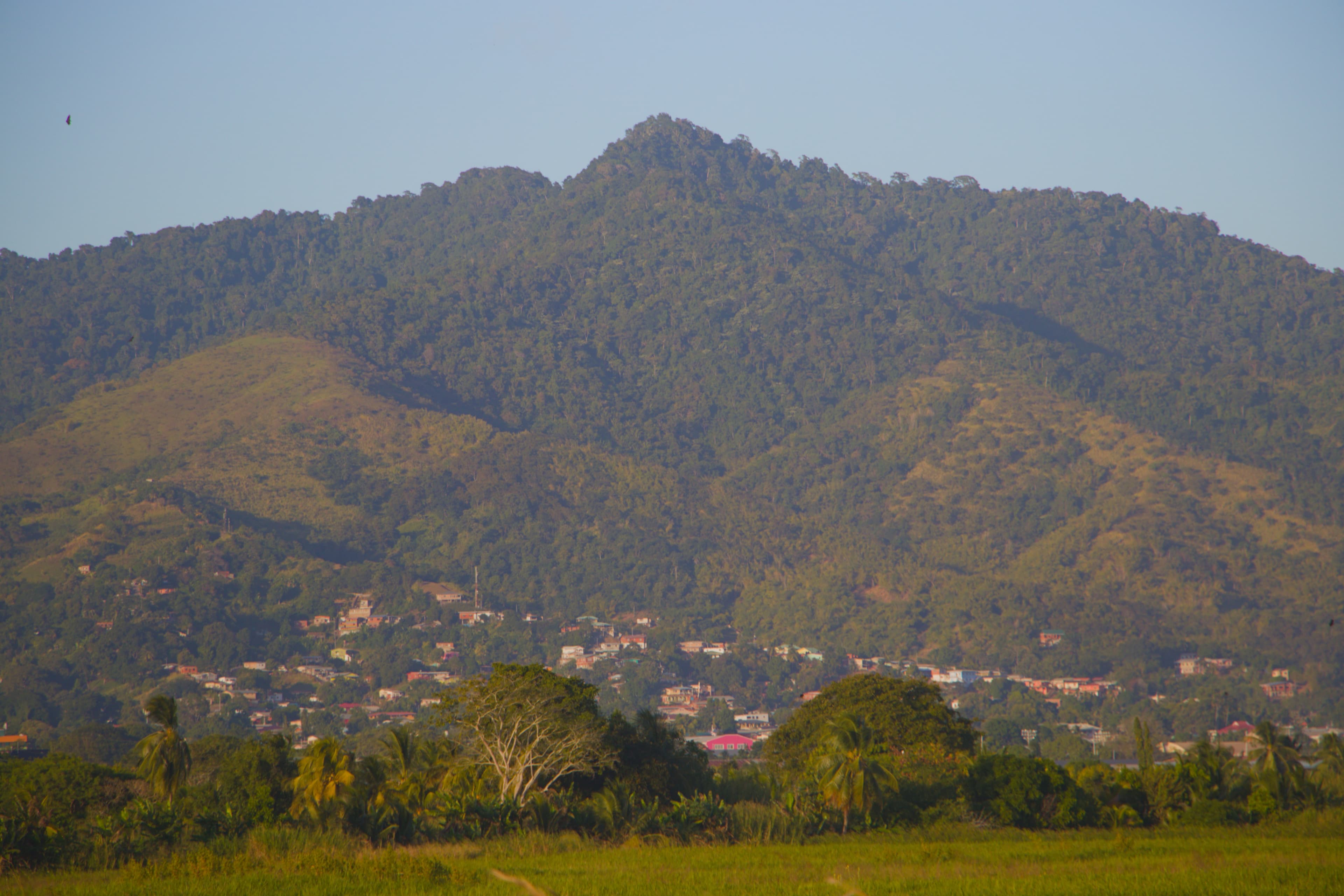
Before dawn on October 10, 2025, officers from the Trinidad and Tobago Police Service moved on an illegal quarrying compound in the Manuel Congo area of Guanapo. What they found was not a small-time hillside operation. The site contained 60-foot pits carved into the earth, artificial ponds draining local water sources, and years of forest destruction visible from satellite imagery. Police seized a multi-million-dollar wash plant, four excavators, three overloaders, a D6 bulldozer, more than ten trucks, ten company vehicles, and two buildings. Nineteen people were arrested and charged under Section 45 of the Minerals Act. The quarry boss and 17 employees were later released on $50,000 bail each.
Police estimated that the operation had been generating more than one million dollars per week.
That single raid brought into focus a sector that the Trinidad and Tobago Extractive Industries Transparency Initiative has called "a missed opportunity" - a phrase that, given the scale of what has since been revealed, may be the most generous description available.
A Sector Where Almost Everyone Is Unlicensed
The licensing numbers tell the story plainly. As of late 2025, only nine companies in Trinidad and Tobago held full licences to mine or process aggregate under the Minerals Act. A further 13 operators functioned under ministerial "holdover" approvals - interim authorities granted while applications are processed. Beyond those 22 operations, at least 90 known quarry sites across the country extract and sell sand, gravel, stone, clay, and other construction materials without licences, without environmental assessments, and without paying the royalties, fees, and taxes the law requires.
The TTEITI's State of the Extractive Sectors 2021 Report estimated that unpaid royalties dating back to 2005 amount to approximately $193 million. When unpaid taxes and other revenue are included, the figure rises to an estimated $800 million owed to the government. That is money extracted from the ground and sold into the same construction market that licensed operators supply - except without the costs of compliance. Legal operators pay licensing fees, post environmental rehabilitation bonds, and submit to regulatory oversight. Illegal operators do none of this, and their material reaches the market at competitive prices because their production costs are lower.
The result is an industry that punishes compliance. The government loses revenue twice - once as uncollected taxes and fees, and again as environmental remediation costs that fall on the state. The communities downstream lose a third time, in water they will never receive.
The Licensing Contradiction
In November 2025, the Trinidad and Tobago Aggregate Producers Alliance staged a protest outside National Quarries Ltd in Turure, Sangre Grande - the state-owned quarrying company. TTAPA president Nigel Tenia accused the government of a double standard: private operators were being raided and arrested while National Quarries itself, he claimed, was processing sand and gravel without a valid processing licence under the Minerals Act. Twenty-four privately owned aggregate companies shut down operations nationwide, warning that as many as 100,000 jobs across the construction sector were at risk.
The core of TTAPA's complaint was that 25 years after the Minerals Act was passed, the Ministry of Energy and Energy Industries had not issued processing licences for sand and gravel. More than 50 licence applications remained pending with the Ministry, some for over four years. Energy Minister Dr. Roodal Moonilal rejected the claim, stating that "numerous Processing Mineral Licences" had been granted. But his statement did not specify which companies received them, when they were granted, or for what materials. The public licensing record remained opaque.
This is the central paradox of the quarrying sector: the government raids unlicensed operations and arrests their workers, while the licensing system that would bring those operations into compliance has, by multiple accounts, failed to process applications for years. The operators who want to be legal cannot get licences. The operators who do not care about legality continue extracting. And the sector as a whole remains a governance failure dressed up as an enforcement success.
What the Hillsides Lose
The environmental consequences of illegal quarrying are not abstract. In June 2025, a quarrying contractor in the Sangre Grande area was pumping tonnes of silt directly into tributaries feeding the Guanapo River. The contamination reached the Caroni Water Treatment Plant, forcing the Water and Sewerage Authority to implement enhanced purification measures and reducing water availability for thousands of residents served by the facility. WASA publicly condemned the discharge. The same operator had been flagged for the same violation in March 2025. A similar incident by the same operator had disrupted the plant in 2021.
The repetition is the point. The same operator, the same river, the same treatment plant - disrupted three times across four years. The enforcement response has not changed the behaviour because the economics have not changed. As long as the expected profit from illegal quarrying exceeds the expected cost of being caught, the activity continues.
Trinidad and Tobago's water supply depends on forested watersheds in the Northern Range. These forests capture rainfall and feed the rivers and aquifers that supply communities from Port of Spain to Arima and beyond. When those forests are cleared and the hillsides excavated, the water capture capacity is permanently reduced. The village of Acono has lived with the consequences of quarry operations for more than 70 years - polluted rivers, dust clouds, respiratory illness, and water shortages as sources become blocked by debris. Communities in Wallerfield have described being "under siege" from illegal operators. Residents across northeast Trinidad have reported the same pattern: cleared vegetation, eroded hillsides, polluted streams, and declining water availability.
The IWEco project, supported by the Global Environment Facility, has attempted to rehabilitate abandoned quarry pits in northeast Trinidad. But rehabilitation after the fact cannot replace the watershed capacity lost during years of unregulated extraction. A destroyed hillside takes decades to recover, if it recovers at all.
The Violence Connection
In November 2025, Police Commissioner Allister Guevarro issued a warning to illegal quarrying syndicates that reframed the sector in terms the environmental damage alone does not capture. Guevarro stated that illegal quarrying has long been fuelling homicides, extortion, and gang activity. The Commissioner noted that while some individuals involved in quarrying had tried to portray themselves as victims, they were engaged in criminal activity that exploits national resources and finances organized crime.
The connection is structural. A single illegal operation can produce more than a million dollars per week in untraceable cash - the kind of revenue that attracts the same criminal networks controlling other underground economies in Trinidad and Tobago. Between 2020 and 2025, 47 people were arrested and charged for offences related to illegal quarrying. The arrests did not stop the flow of money or the violence surrounding it.
The Danny Guerra case connects illegal quarrying directly to a political-criminal nexus. Guerra was charged in October 2025 for unlawful processing of aggregate without a licence. In November 2025, he was detained in connection with an alleged assassination plot against a government minister - police identified him as the leader of an organized crime group involved in illegal arms trafficking, money laundering, and illegal quarrying. In March 2026, he was shot dead by two masked gunmen at his business site in Sangre Grande. The Trinidad and Tobago Transparency Institute subsequently raised questions about the murdered businessman's connections to political figures, calling for campaign finance legislation that would make such relationships traceable. The sequence - arrest, assassination plot, murder - describes a political-criminal nexus that goes well beyond unlicensed aggregate processing. In a separate case, a landowner who fought to protect his property from illegal quarrying received death threats and had his vehicle shot up.
This is not a story about environmental policy alone. It is a story about how an unregulated multi-billion-dollar industry creates the conditions for violence, corruption, and the erosion of state authority.
The Penalty Question
The Finance Bill 2014 increased penalties for illegal quarrying under the Minerals Act. A first conviction now carries a fine of $500,000 and up to five years imprisonment, up from $200,000 and two years. A subsequent conviction carries $700,000 and seven years, up from $300,000 and three. For those who trade in minerals without a licence or make fraudulent representations, the penalties reach $1.5 million and 15 years.
Whether these penalties are being applied is a different question. The 19 workers arrested in the Manuel Congo raid were released on $50,000 bail each. The legal process that follows - whether it results in convictions, what fines are imposed, whether custodial sentences are handed down - will determine whether the penalty regime functions as a deterrent or merely as a cost of doing business that operators can absorb.
The Ministry published an illegal quarrying penalties flyer in October 2025, signalling awareness that the public may not know the consequences exist. But awareness is not enforcement. The question is whether institutional capacity exists to prosecute illegal operators at the scale the problem demands - systematically, across 90-plus unlicensed sites, not one raid at a time.
What Would Change This
The ingredients for reform have been identified repeatedly - by the TTEITI, by the aggregate producers, by environmental organizations, and by the police. A functional licensing system that processes applications within reasonable timeframes. A public register of licence holders. Satellite monitoring of quarry sites. Environmental bonds that are actually collected. Penalties consistently applied, not selectively enforced.
Until those changes arrive, the pattern continues. The hillsides are excavated. The rivers run brown. The water supply diminishes. The money flows untaxed into an economy that rewards extraction and punishes compliance. And the communities downstream - in Guanapo, in Acono, in Wallerfield, across the Northern Range foothills - bear the cost of a governance failure that has persisted for decades.
The watersheds will not wait for the licensing system to catch up.
Sources
- Newsday: "Cops move to crush illegal quarries" (November 2025)
- Newsday: "[UPDATED] Quarry boss, 17 others out on $50,000 bail" (October 2025)
- Newsday: "[UPDATED] $m Manuel Congo site shut down - Illegal quarry boss nabbed" (October 2025)
- Newsday: "Illegal quarry operator disrupts Caroni water supply" (June 2025)
- Newsday: "CoP Guevarro leads police operation at illegal quarry site" (July 2025)
- Newsday: "Quarry operators accuse State of double standard" (November 2025)
- Newsday: "Police Commissioner sends warning to illegal quarrying syndicate: Cease and desist" (November 2025)
- Newsday: "Quarrying in Trinidad and Tobago" (February 2023)
- Trinidad Guardian: "CoP warns illegal quarrying fuels gangs and homicides" (November 2025)
- Trinidad Guardian: "24 quarries on strike: Operators demand processing licences amid Govt scrutiny" (November 2025)
- Trinidad Guardian: "Crackdown on illegal quarrying - 57 fined by Energy Ministry, 44 shut down"
- Trinidad Guardian: "Businessman held over alleged plot to assassinate Govt Minister" (November 2025)
- Trinidad Guardian: "WASA condemns illegal discharge into Guanapo River" (2025)
- Trinidad Express: "19 held in quarry raid" (October 2025)
- Trinidad Express: "Aggregate companies shut down, demand Govt meeting" (November 2025)
- Trinidad Express: "The quarrying quandary" - Editorial (2025)
- Trinidad Express: "Quarrying, a disaster sector" - Editorial (2021)
- CNC3: "Death threats for landowner, illegal quarry operator rakes out millions in aggregate"
- CNC3: "Illegal Wallerfield quarries continue to operate with impunity"
- Stabroek News: "24 quarries on strike in Trinidad" (November 2025)
- Stabroek News: "Trinidad businessman held over alleged plot to assassinate Govt Minister" (November 2025)
- Stabroek News: "Trinidad businessman who was detained under last SoE for threatening Minister killed" (March 2026)
- The Cool Down: "Authorities uncover yearslong criminal enterprise" (Guanapo raid)
- TTEITI: State of the Extractive Sectors 2021 Report - quarrying sector characterisation
- Ministry of Energy and Energy Industries: Illegal Quarrying Penalties Flyer (October 2025)
- Ministry of Energy and Energy Industries: Quarrying sector overview
- Government of Trinidad and Tobago: Energy Ministry statement on illegal quarrying
- Cari-Bois Environmental News Network: "Irresponsible Quarrying Hurting Communities, Forests & Wildlife in T&T" (2021)
- Cari-Bois Environmental News Network: "A Plea for Acono: Living in the Shadow of a Quarry" (2020)
- Global Voices: "Community in Trinidad says 'No' to quarry operator targeting area's last untouched watershed" (2021)
- IWEco: "Rehabilitating quarry land in North East Trinidad"
- Minerals Act Chapter 61:03, Laws of Trinidad and Tobago
- CNC3: "Transparency Institute urges Govt to prioritise campaign finance laws" (2026)