Since February 28, 2026, the commodity price environment for Trinidad and Tobago's core exports has been the strongest in years. Brent crude has climbed from roughly US$70 per barrel before the US-Israeli strikes on Iran to approximately US$119 by the end of March. The European gas benchmark TTF has surged from around EUR 38 per megawatt-hour to EUR 55 - a jump of more than 70 percent in a single month. Urea prices have leapt from US$482 to US$720 per tonne. Ammonia has moved from US$495 to US$600. Methanol delivered into Southeast Asia has surged 72 percent to US$555 per metric tonne, while CFR China methanol climbed from US$280 to over US$400. Every major commodity that Trinidad and Tobago exports is trading at multi-year highs, some at levels not seen since 2021 or 2022.
Energy Minister Moonilal acknowledged that higher prices "could boost T&T revenues." He was careful with the word "could." The Central Bank, in its March 2026 Monetary Policy Announcement, warned that the war "added further downside risks to projected global economic activity." Former Prime Minister Stuart Young said the cost of living would increase from shipping disruption.
All three statements are true simultaneously, and together they describe a paradox that defines Trinidad and Tobago's current economic position - arguably the most frustrating paradox in the country's modern fiscal history.
The Windfall That Cannot Be Captured
The scale of the disruption matters. Iran's closure of the Strait of Hormuz on March 4 - described by the International Energy Agency as the largest disruption to global energy supply since the 1970s oil crisis - has removed approximately 20 percent of the world's oil supply and a significant share of global LNG volumes from the market. QatarEnergy declared force majeure on all LNG exports. Qatar's refineries suspended ammonia and urea production. Saudi Arabia's petrochemical output has been severely affected. The Middle East accounts for 23 percent of global ammonia trade, shipping out 4.2 million tonnes in 2025. An estimated 18 percent of global methanol capacity has been knocked offline.
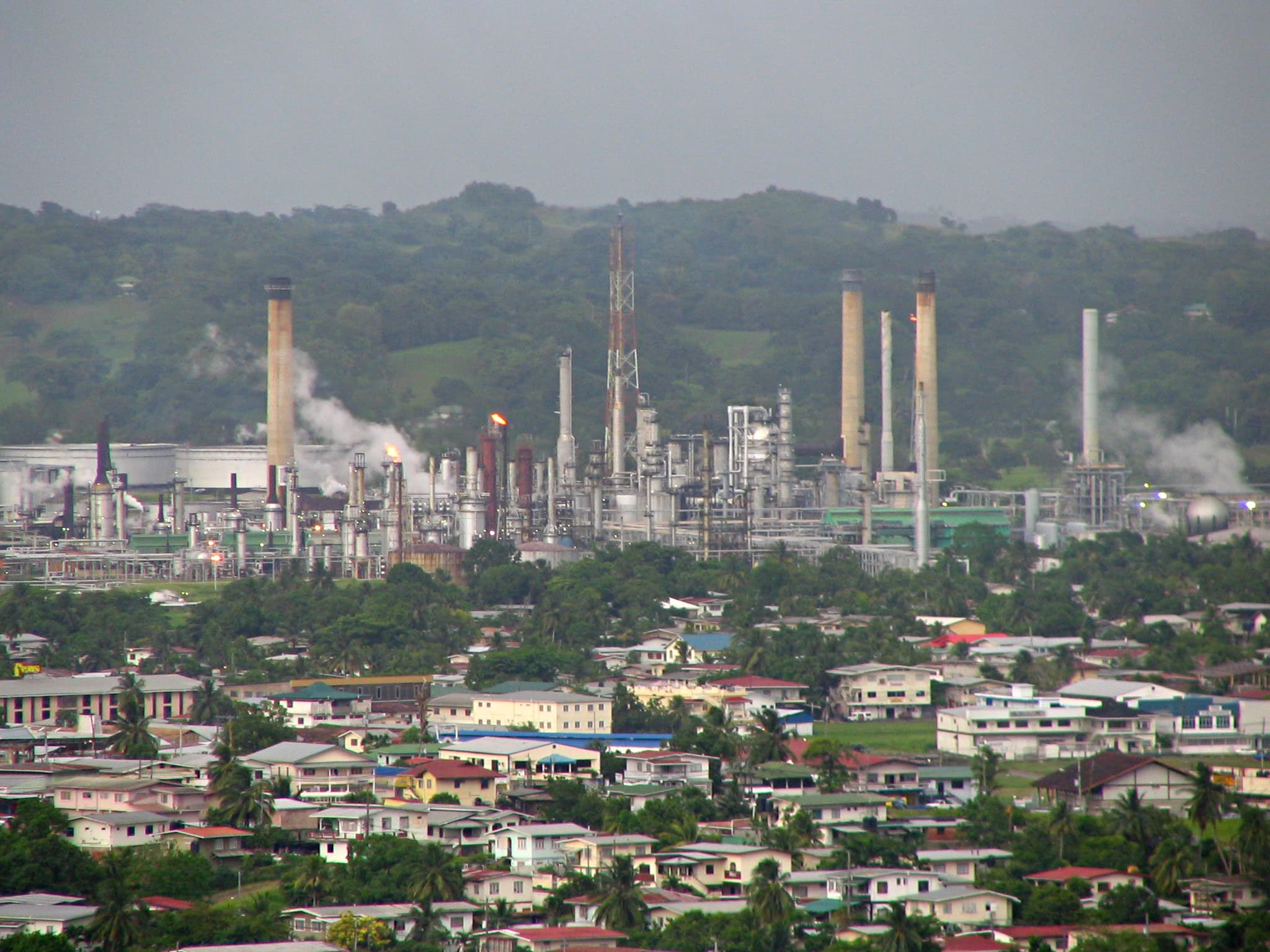
For a country that exports LNG, ammonia, urea, and methanol, this should be the fiscal equivalent of winning the lottery. Trinidad and Tobago is one of the world's largest ammonia exporters. It has an operational LNG facility at Point Fortin. It hosts methanol plants operated by Methanex and Proman at Point Lisas. Every one of those products is now commanding prices that would have seemed fanciful six months ago.
The problem is that Trinidad and Tobago cannot produce enough of any of them to capitalise.
Natural gas production has fallen from a peak of approximately 4.3 billion cubic feet per day in 2010 to around 2.5 bcf/d - a decline of more than 40 percent in fifteen years. This is not a temporary dip. It is a structural decline driven by the maturation of legacy fields, underinvestment in exploration during low-price years, and the slow pace of new project development. The decline spans both governments. PNM-era flagship projects at Petrotrin had combined cost overruns of TT$14.25 billion before the refinery was shuttered. The current UNC government has not initiated new production projects since taking office. Neither party built the exploration pipeline that would have kept production stable through the 2020s.
Atlantic LNG, the country's flagship liquefaction facility at Point Fortin, was designed for a gas supply that no longer exists at current production levels. Train 1, with a capacity of 3 million tonnes per year, was permanently decommissioned in March 2025. Then, on February 11, 2026 - just days before the Middle East war began - Train 3 was shut down for emergency repairs after a crack was discovered in its flaring system. That repair is expected to take at least a month. A separate planned 50-day maintenance shutdown of Train 4 is scheduled for May and June. At the precise moment when global LNG prices are surging, Trinidad and Tobago has one train permanently gone and another offline for emergency repair at a facility already running below capacity because there is not enough gas to feed it.
Nutrien, one of the largest ammonia producers at Point Lisas, has been shut down since the National Gas Company cut off its gas supply on January 1, 2026. The dispute - over retroactive port fees of US$28 million and gas pricing terms - has taken more than 500 jobs offline and disrupted the country's CO2 supply chain, which is critical for medical, food, and industrial use. At pre-war prices, the Nutrien shutdown was costly. At current prices, with ammonia at US$600 per tonne and rising, the lost revenue is staggering. Farm Progress reported that the Trinidad shutdown alone could pressure global ammonia and fertiliser markets. Now that Qatar's ammonia production has also halted, every tonne of Trinidad ammonia that is not being produced represents a compounding loss.
Methanex, which operates two methanol plants at Point Lisas with a total capacity of over 2.5 million tonnes annually, has been cycling plants on and off due to gas supply constraints. In September 2024, the company restarted its Titan plant while idling its Atlas plant - a net capacity reduction of over 200,000 tonnes. The Energy Chamber has acknowledged that gas supply constraints represent the most significant challenge facing methanol producers in the country.
The picture is complete: the plants are there, the markets are paying historic prices, and the gas is not flowing at the volumes needed to capitalise.
The Import Cost
The same disruption that raises export prices also raises import costs. Trinidad and Tobago imports food, manufactured goods, machinery, and consumer products. The closure of the Strait of Hormuz and elevated insurance premiums for maritime trade routes increase the cost of everything that comes into the country. Brent crude at US$119 per barrel means higher fuel costs globally, and those costs feed directly into food, transportation, and electricity generation - even for energy producers.
For a population already dealing with forex rationing, credit card limits of US$100 to US$200 per month, and a parallel market exchange rate above the official TT$6.80, higher import costs compound an existing squeeze. The windfall from higher energy prices arrives, to whatever extent it materialises, in the government's accounts. The increased import costs arrive at the grocery store, the hardware, and the pharmacy.
The net effect depends on the balance between export revenue gains and import cost increases. The Trinidad Express has reported that not every dollar of the commodity price spikes will flow instantly into the Treasury, because contracts, outages, and production volumes matter. No comprehensive public analysis has been conducted to determine which effect dominates. The answer likely varies by income level: Trinbagonians with greater exposure to energy sector employment benefit from the revenue side, while lower-income households, which spend a higher proportion of their income on food and consumer goods, absorb the import cost side disproportionately.
The IMF's 2026 Article IV Mission, which concluded just weeks before the war began, projected only 1.2 percent real GDP growth for Trinidad and Tobago and estimated the central government's fiscal deficit at 5.5 percent of GDP for FY2025. IMF staff recommended targeting a 3.5 percent of GDP deficit for FY2026 through additional revenue measures. The war-driven commodity price spike may improve energy revenues, but the IMF's broader assessment - that stagnant production in the mature energy sector has weighed on economic activity - describes a structural reality that higher prices alone cannot fix.
The Bridge Year
The energy industry talks about 2026 as a "bridge year." The major projects that are expected to reverse the production decline - bpTT's Ginger and Mento developments, Shell's Manatee and Aphrodite fields, EOG and bpTT's Coconut platform currently under construction at TOFCO yard - all point to 2027 for first gas. Shell's Manatee alone could reach 104,000 barrels of oil equivalent per day at peak, and together the new projects could supply up to one billion cubic feet of additional natural gas by 2028.
But 2027 is not 2026. The bridge year is precisely the year when the commodity price windfall arrived. By the time the new production comes online, the Middle East conflict may have resolved, prices may have normalised, or the window of extraordinary prices may have closed. Energy markets are cyclical and geopolitically driven. There is no guarantee that the conditions of March 2026 will persist into 2028.
The Dragon Gas project, discussed for over forty years and potentially holding 10 trillion cubic feet of natural gas in the cross-border Loran-Manatee field, remains without a Final Investment Decision. Following the US military extraction of Venezuelan President Maduro in January 2026, Foreign Minister Sobers acknowledged there was "no certainty" on Dragon gas. Shell and BP have filed new OFAC licence requests, and the US has issued general licences for Trinidad and Tobago energy activities in Venezuela, but the geopolitical situation remains fluid. Shell targets FID and first production in late 2027 - again, not 2026.
What the War Reveals
The Middle East conflict did not create Trinidad and Tobago's energy production decline, its import dependency, or its petrochemical plant shutdowns. It illuminated all three simultaneously, under the harshest possible light.
A country with robust gas production would be in a position to narrow its fiscal gap, rebuild foreign exchange reserves, and fund the infrastructure commitments in the 2026 budget. Instead, the price spike arrives at a moment of production decline, emergency plant shutdowns, a contract dispute that has taken a major ammonia producer offline, an LNG facility operating with one train permanently gone and another under repair, and methanol plants cycling on and off for lack of feedstock.
Columnists at the Trinidad Express have warned that unless Trinidad and Tobago uses whatever windfall does materialise to address the underlying vulnerabilities of the economy, the country will remain caught in a repetitive cycle. The observation is not new. It has been made after every commodity price spike since the 1970s. What is new is the convergence of high prices with low production - a combination that previous windfalls never had to contend with.
The paradox is complete: the best commodity price environment in years, arriving at the worst production moment in decades, in an economy that needs the revenue more than it has in a generation. The window of high prices may last months or years - Middle East conflicts have historically sustained elevated energy prices for extended periods. But Trinidad and Tobago's ability to benefit depends on production recovery that is still under development, plant restarts that remain mired in disputes, and infrastructure repairs that are ongoing at the worst possible time.
The money is on the table. The country cannot pick it up.
Sources
- Central Bank of Trinidad and Tobago: Monetary Policy Announcement (March 2026)
- IMF: Staff Concluding Statement of the 2026 Article IV Mission (February 10, 2026)
- Trinidad Express: "Higher LNG prices could aid T&T" (March 2026)
- Trinidad Express: "Export gains must become public revenue" (March 2026)
- Trinidad Express: "Another windfall, another warning: will we learn?" (March 2026)
- Trinidad Guardian: "CDB: Middle East war could impact region immediately" (March 2026)
- CNC3: "The importance of diplomacy and economic geography" (March 2026)
- IEA: Oil Market Report (March 2026)
- Al Jazeera: "Iran war threatens prolonged impact on energy markets" (March 8, 2026)
- CNBC: "Brent oil closes at $100 after Iran's new supreme leader says Strait of Hormuz must remain closed" (March 12, 2026)
- CNBC: "Oil prices close at highest level since 2022 as Iran negotiations fail" (March 27, 2026)
- Pipeline & Gas Journal: "Atlantic LNG Shuts 3 MMtpy Train 3 for Emergency Repairs" (February 2026)
- Pipeline & Gas Journal: "Trinidad's Atlantic LNG Plans 50-Day Shutdown of Train 4" (February 2026)
- S&P Global: "Global methanol prices soar in response to Middle East war" (March 2026)
- CRU Group: "Urea supply disruptions could be catastrophic" (March 2026)
- Western Producer: "Middle East conflict sends ammonia prices higher" (March 2026)
- Profercy: "Ammonia prices firm on Middle East supply shock" (March 2026)
- Farm Progress: "Trinidad shutdown could push ammonia price" (January 2026)
- Energy Chamber of Trinidad and Tobago: Q1 2026 Survey
- Trinidad Guardian: "Energy services companies report decline in business in Q1 2026"
- Trinidad Express: "BP and Shell gear up for 2027 production surge in T&T"
- S&P Global: "Arresting the decline: Trinidad and Tobago's natural gas supply alternatives"
- Caribbean Council: "Trinidad and Tobago set for 2027 gas production surge"
- World Economic Forum: "The global price tag of war in the Middle East" (March 2026)
- Kaieteur News: Dragon Gas analysis (March 2026)