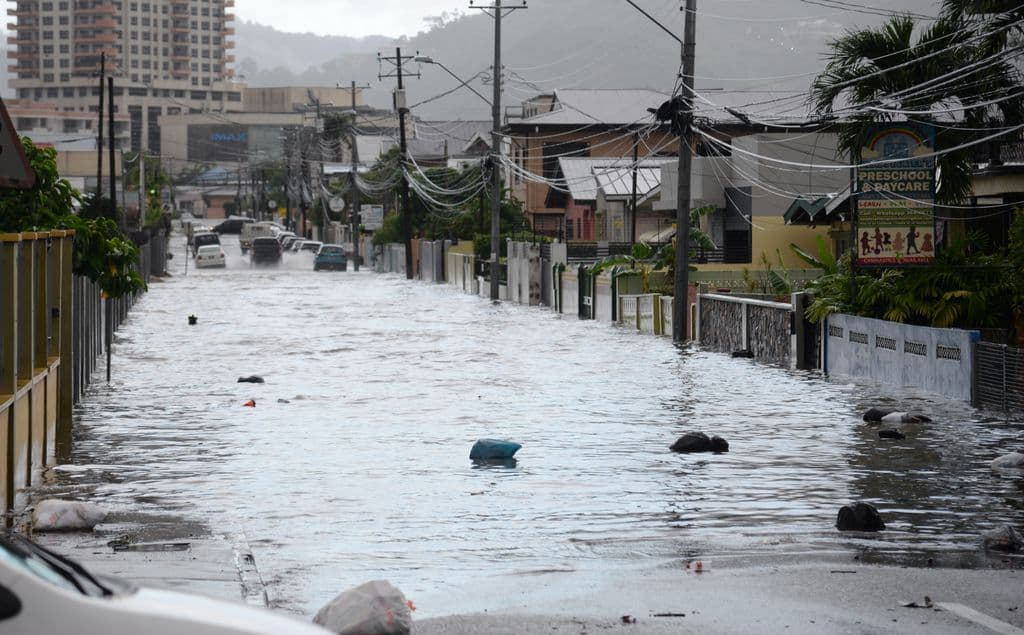
Greenvale floods. Penal/Debe floods. Diego Martin floods. Cocorite floods. The Caroni basin overflows. Southern communities along the Oropouche watershed go under. These are not breaking news events. They are calendar events, as predictable as Carnival and as resistant to government intervention as anything in the country's recent history.
Budget 2026 allocated $30 million for the Flood Mitigation and Erosion Control Programme, $78.5 million for local drainage across 14 municipal corporations, and $5 million for the Major River Clearing Programme. These numbers are not new. Similar amounts appeared in previous budgets. The communities they are supposed to protect flooded last year, and the year before, and the year before that. The reasonable question is no longer whether the money is sufficient. It is whether the approach itself is capable of producing a different outcome.
The Annual Ritual
Approximately 40 percent of Trinidad and Tobago's population experiences flooding annually. That figure comes from the national disaster risk profile, and it has not improved meaningfully in decades. In severe events, the proportion rises dramatically. The October 2018 floods - two days of rainfall equivalent to a full month's total - affected an estimated 150,000 people across more than 4,100 households and devastated 75 percent of local farmers through crop and livestock losses. Between 1990 and 2020, cumulative flood damage was recorded at approximately $3.8 million, of which $3.7 million came from the single 2018 event. That concentration tells you something about the difference between chronic low-level flooding and the kind of event that overwhelms everything at once.
The pattern is consistent across administrations. The PNM budgeted for flood mitigation and the same areas flooded. The UNC budgets for flood mitigation and the same areas flood. The drainage infrastructure was designed for rainfall volumes that no longer reflect reality. Climate change has intensified wet-season precipitation. The built environment has expanded into flood-prone areas. Hillside quarrying has stripped vegetation that once absorbed runoff. And the institutional response has remained essentially unchanged: clear some drains, allocate some money, express sympathy when the water rises, repeat.
The June 2025 flooding was instructive. Tropical Wave 04 and a low-level trough delivered 200 to 300 millimetres of rainfall across northern areas over three days. The Caroni River reached 94 percent capacity at El Carmen and overflowed near Tumpuna, inundating communities from St Helena to Valsayn South. In the south, floodwaters in Penal and Debe reached 1 to 1.5 metres inside homes. Five months later, in November 2025, the same communities flooded again. In January 2026, during the dry season, flash flooding hit Barrackpore, Diego Martin, Cocorite, and Port of Spain.
Rural Development Minister Khadija Ameen said after the January event that there was "no major impact." For the people whose furniture was soaked and whose cars stalled in floodwater, the phrase lands differently.
The Drainage Gap
The $78.5 million allocated for local drainage sounds significant in isolation. Divided across 14 municipal corporations, it averages roughly $5.6 million per municipality. For Port of Spain - a city built on reclaimed land, with colonial-era drainage infrastructure designed for weather patterns that no longer exist - $5.6 million is maintenance money. It keeps the existing system running at its existing capacity. It does not expand capacity. It does not address the fundamental mismatch between how much water falls and how much the system can move.
The distribution of that money carries its own complications. The chronic flooding analysis published on this site documented that all PNM-controlled municipal corporations received decreased drainage allocations in the 2026 budget, while all UNC-controlled corporations received increases. Point Fortin's drainage budget fell from $5 million to $300,000. Chaguanas saw a 122.5 percent increase. Flooding does not observe partisan boundaries. Water does not know which party controls the regional corporation. A drainage allocation that tracks political affiliation rather than hydrological need is not a flood mitigation strategy. It is patronage by another name.
The Workers Who Are Gone
This is where the flooding problem collides with a different policy failure.
CEPEP and URP workers were the people who cleared the drains. Not the major river systems - those fall under the Ministry of Works and the municipal corporations - but the community-level drains, the roadside culverts, the secondary channels that carry water from residential areas to the main drainage network. Over 10,500 CEPEP workers under 330 to 360 contractors maintained drainage, cleared vegetation, and managed the unglamorous physical labour that prevents small blockages from becoming neighbourhood floods.
Those workers were terminated in June and July 2025. The URP workers followed in September. The replacement was 220 workers deployed nationally across all 14 municipal corporations. In Port of Spain, where over 500 CEPEP and URP workers had been operating, 12 replacements were assigned. They arrived without tools.
The wet season began in June. The workers were fired in June. The drains that had been maintained, however imperfectly, by thousands of community-based labourers were left to whatever the municipal corporations could manage with their existing staff - which, in most cases, was not enough. The November flooding in Penal/Debe occurred after the drainage maintenance workforce had been reduced by more than 95 percent.
The government has never publicly connected the termination of CEPEP and URP workers to the flooding outcomes that followed. The two policy decisions - ending the community maintenance programmes and budgeting for flood mitigation - exist in separate ministerial silos. But the drains do not know which ministry is responsible for them. They either get cleared or they do not.
Why the Engineering Keeps Failing
The research on flood mitigation in Trinidad and Tobago does not offer much comfort to anyone who believes the current approach will eventually work if given enough money.
A UWI study on detention basin placement found that optimally located detention basins - the engineering solution most commonly proposed for managing peak flood flows - reduced flood damage by only 12.86 percent. That is the best-case scenario with optimal placement. Actual placement is constrained by land availability, cost, political considerations, and the willingness of communities to accept a detention pond in their neighbourhood. The real-world damage reduction is likely lower.
The IDB approved a US$120 million loan for the Port of Spain Flood Alleviation Project years ago. The project scope includes drainage interceptors, detention ponds, pumping stations, and a linear park in East Port of Spain. A drainage scheme and detention pond were completed at South Quay. But the broader project remains behind its original timeline, and Port of Spain continues to flood with regularity. International development project timelines and tropical rainfall operate on different calendars.
The Adaptation Fund committed US$10 million for the South Oropouche River Basin project, implemented through CAF and the University of the West Indies. The South Oropouche Basin is the critical zone for Penal/Debe - approximately 60 percent of the municipality lies within the watershed. The basin experiences high-intensity flooding roughly ten times per year, with basin-wide deep-water events becoming nearly annual. Economic losses in the SORB alone range from US$19 to US$36 million annually. The project launched in 2023. The communities it serves flooded in 2024, 2025, and early 2026.
None of this means the projects are worthless. Interceptors and detention ponds and pumping stations all help. But they help at the margins, and the problem is growing faster than the marginal solutions can be deployed.
The Quarrying Problem
Upstream of the flooding, in the hills and watersheds that determine how much water reaches the drainage system, illegal quarrying has been stripping the landscape for decades. Vegetation that once absorbed rainfall and slowed runoff has been removed. Topsoil has been destabilised. Sedimentation has increased in river channels, reducing their carrying capacity.
The illegal quarrying analysis published on this site documented that only eight quarrying operations in Trinidad and Tobago hold valid licences. Unpaid royalties to the state have accumulated to approximately $193 million since 2005. The environmental cost - bare hillsides, unstable slopes, silted-up waterways - is not captured in that figure. It shows up downstream, when the rivers that receive the runoff from stripped hillsides overflow into the communities below.
The connection between quarrying and flooding is not theoretical. It is hydraulic. Remove vegetation from a hillside and the water that falls on it reaches the river faster, carrying more sediment, with greater peak flow. The rivers and drainage channels downstream were not built for those flows. They overtop. Houses flood.
Enforcement of quarrying regulations has been effectively nonexistent for decades. No government - PNM or UNC - has demonstrated the political will to shut down illegal operations, collect unpaid royalties, or require rehabilitation of damaged sites. The operators are politically connected. The communities downstream are not.
What Would Actually Work
What would a different approach actually look like? The current model treats flooding as a drainage problem: clear the drains, build the ponds, pump the water, allocate the budget. It addresses symptoms after they appear. The alternative is to treat flooding as a land use and watershed management problem - one that requires intervention far upstream of where the water arrives.
Green infrastructure - permeable surfaces, bioswales, constructed wetlands, urban tree canopy, rain gardens - is largely absent from Trinidad and Tobago's policy framework. None of this is exotic. Singapore, Copenhagen, and dozens of cities that receive comparable or greater rainfall treat these as standard practice. They absorb and slow water before it reaches the drainage system, reducing peak flows and giving the engineered infrastructure a chance to keep up.
Watershed rehabilitation - reforesting stripped hillsides, enforcing quarrying laws, restoring natural drainage paths - would reduce the volume and speed of water entering the system. It is slower and less visible than building a pumping station, which is why no minister mentions it in a budget speech.
Land use regulation would reduce the number of people and structures exposed to flooding in the first place. That means prohibiting construction in flood zones, requiring flood-resilient building standards in vulnerable areas, and refusing to extend utilities to developments built in known flood plains. Every new housing development in a low-lying area without adequate drainage adds demand to a system that is already overloaded.
None of this produces results within a single budget cycle. None of it makes for a good ribbon-cutting. It all requires sustained investment over decades and a willingness to tell voters that some areas should not be built on - which is why it does not happen.
The current approach requires none of those things. It requires only that money be allocated, sympathy be expressed, and the cycle be repeated. It has been repeated for decades. The results are visible in June, and again in November, and sometimes even in January.
The Cycle Continues
The 2026 wet season will begin around June. The Caroni basin will fill. The South Oropouche will overflow. Diego Martin will flood. Penal will flood. The municipal corporations will respond with what they have. The 220 replacement workers - if they have received tools by then - will do what they can. The $30 million will be spent or committed. And the same communities that flooded in 2025 and 2024 and 2023 and 2018 will flood again.
This is not a prediction. It is a description of what happens when none of the inputs to a system change. The rainfall will not decrease. The drainage capacity has not meaningfully increased. The watersheds have not been rehabilitated. The quarrying has not been stopped. The CEPEP workers who cleared the secondary drains have not been replaced. The land use policies that permit development in flood-prone areas have not been reformed.
The $30 million is not the problem. The problem is that $30 million allocated within a system that has failed for decades will produce the same result the system has always produced. Different outcomes require different approaches. Trinidad and Tobago has not tried one yet.
Sources
- Ministry of Finance: Budget Statement 2026 - flood mitigation and drainage allocations
- T&T Parliament: Ministry of Works and Infrastructure Budget Guide 2026
- Newsday: "No major damage after Jan 22 flash flooding" (January 23, 2026)
- Newsday: "Flash flooding in Penal, corporation says mitigation works coming" (November 20, 2025)
- The Watchers: "Heavy rainfall triggers widespread flooding and infrastructure damage across Trinidad" (June 12, 2025)
- ReliefWeb: "Trinidad and Tobago - Floods October 2018"
- ECLAC: "An economic analysis of flooding in the Caribbean - The case of Jamaica and Trinidad and Tobago"
- IDB: "Trinidad and Tobago to alleviate flooding in Port of Spain with IDB loan"
- Adaptation Fund: "Multi-Pronged Adaptation Approach Brings Flood Relief to Trinidad's Vulnerable South Oropouche River Basin"
- CAF: "USD 10 million project for flood relief in Trinidad and Tobago" (October 2023)
- UWI: Detention basin placement and flood damage reduction study
- Trinidad and Tobago National Adaptation Plan (2024)
- Ministry of Rural Development and Local Government: Municipal corporation drainage allocations (2026)
- Trinidad Guardian: Budget analysis - municipal corporation funding disparities (October 2025)
- World Bank Climate Change Knowledge Portal: Trinidad and Tobago - Historical Natural Disasters
- Cari-Bois: "From historic floods to water shortages - a look at Trinidad and Tobago's changing climate" (April 2025)