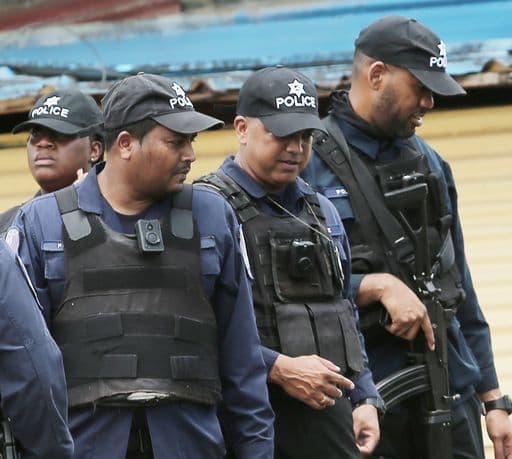
Trinidad and Tobago's police service acquired approximately 1,000 body cameras. For Carnival 2026, only 180 were operational. The remaining 820 were not broken, lost, or obsolete. They were rendered useless because the Police Service halted a multimillion-dollar international licensing contract that the cameras require to function. As of June 2025, only 17.9% of officers were using cameras. The Police Complaints Authority has never received body-worn camera footage from the TTPS - not once in the eight years since the devices were first introduced.
This is not a procurement failure. The cameras exist. The infrastructure works. The 180 that are operational prove the system functions. The problem is that someone decided the other 820 should not.
The Shooting That Changed the Conversation
On or around January 24, 2026, CCTV footage went viral showing officers fatally shooting Joshua Samaroo, 31, in St Augustine after a police chase. The footage showed Samaroo's car crashing, after which he appeared to roll down his window and raise his hands. Three officers emerged from the police SUV and opened fire within seconds. At least 17 shots were fired. Samaroo was struck repeatedly and slumped in the driver's seat. His common-law wife, Kaia Sealy, 31, was critically injured and left paralysed.
No body-worn camera footage existed for the incident. No dashboard camera footage either. The family demanded the Commissioner disclose any recordings, ballistic reports, or witness statements supporting the police claim of an exchange of gunfire. Protesters demanded the resignations of Commissioner Allister Guevarro and Homeland Security Minister Roger Alexander. The officers involved were placed on administrative duties.
The Samaroo case was not an isolated event. Fatal police shootings surged from 37 in 2024 to 55 in 2025 - a 49% increase. Between January 1 and March 19, 2025, there were 15 police-involved shooting incidents leaving 21 people dead, compared to 6 incidents and 9 dead in the same period of 2024 - a 133% increase. PCA Director David West described the trend as "disturbing." He confirmed there was no record of body-worn camera footage on any of the 2025 incidents.
The Contract That Was Killed
The procurement history reveals layers of dysfunction. The initial batch of 750 cameras, followed by 250 more, cost approximately $4 million including a Bluetooth feature. By 2022, approximately 1,160 cameras had been distributed. Then the programme stalled.
In August 2024, then-Commissioner Erla Harewood-Christopher granted a letter of award to Diamond Systems and Supplies Ltd, a La Romaine company, for 3,000 Huawei EC310 Smart 4K body-worn cameras at $24,965,310. The contract specified a 70% advance payment - an unusually large upfront sum that raised red flags. The advance was never paid. DSSL sent multiple letters requesting it.
In September 2025, Homeland Security Minister Roger Alexander told the Senate the contract was terminated to save money. The Commissioner explained that the cameras were priced at $8,000 per unit under the contract when they could be obtained on the open market for $2,500 to $3,000 - meaning the contract was inflated by roughly 2.5 to 3 times market rate. The question of who approved an inflated contract, and why a 70% advance was included, has not been publicly answered.
The 2026 budget includes $20 million for the TTPS to procure 3,120 new body-worn cameras for frontline officers. Whether this procurement has advanced is unclear.
The Eight-Year Blackout
The most damning fact in the body camera debate is not the 180 operational cameras. It is that the Police Complaints Authority - the independent civilian oversight body established under the Police Complaints Authority Act of 2006 - has never received footage from police body cameras in any investigation. Not once in eight years.
A departmental order mandating body camera use on patrol has existed since 2017. Commissioner Harewood-Christopher had to reissue the order in April 2023, telling officers to wear and turn on their cameras - indicating chronic non-compliance. Former Commissioner Gary Griffith claims there was a standing order under his tenure allowing immediate suspension for non-compliance, but this was evidently not carried forward. There is no legislation specifically mandating body camera use. It remains internal police policy, which officers routinely ignore without consequence.
PCA Director David West, now in his 12th year heading the authority, has stated since 2014 that body cameras are vital for public trust. He has accused officers of ignoring departmental orders. The PCA's investigators themselves began wearing body cameras in May 2024 - doing what the police they oversee will not.
The ZOSO-SoE Swap
The body camera issue crystallised during the Senate debate on the ZOSO bill in January 2026. Independent senators made body cameras a condition of their support. Their reasoning was direct: if the government wants expanded police powers in designated zones, the public needs assurance those powers are being exercised lawfully.
The government rejected the condition. All eight Independent senators voted against the bill. The Prime Minister called them "weak men and women" and "bootlickers," and accused two unnamed senators of seeking "personal favours in exchange for votes."
On March 2, the government declared a State of Emergency instead - which provides broader powers than ZOSO, nationwide, without the body camera requirement. Under the Emergency Powers Regulations, police can enter homes and search without a warrant. The regulations also make it an offence to "endeavour - orally or otherwise - to influence public opinion in a manner likely to be prejudicial to public safety," with wording broad enough to cover social media posts and voice notes.
Police are now conducting arrests, searches, and detentions under SoE powers across Trinidad and Tobago with fewer than 200 operational body cameras for the entire force.
The Trust Collapse
Former Commissioner Griffith publicly called on the incumbent to explain why 1,200 cameras procured under his tenure are not in use. Griffith's own career spans both parties - he served as a UNC advisor and minister from 2000 to 2015 before being appointed Police Commissioner under the PNM in 2018. His reappointment was blocked when the Police Service Commission Chair withdrew the merit list after meeting Prime Minister Rowley. Griffith is also a prosecution witness in the Anand Ramlogan corruption case. His cross-party trajectory makes him both an unusual critic and a reminder that policing in Trinidad and Tobago has never been insulated from political interference, regardless of which party governs. He noted that public confidence in the police stood at 59% during his time, compared to a recent survey placing it at 8%. Justice Frank Seepersad, ruling on a case in January 2026, called for mandatory body camera use and urged citizens to record police encounters with cellphones and CCTV until cameras are mandated. He described the erosion of public trust in the TTPS as "disturbing and deplorable" and called for legislative reform to make errant officers personally pay for court-awarded damages rather than taxpayers.
Jamaica provides a regional benchmark. The Jamaica Constabulary Force has deployed 750 body cameras with 1,000 acquired, beginning with a 2016 pilot in collaboration with the US Embassy. Jamaica's Independent Commission of Investigations has raised similar concerns about officers failing to activate cameras during planned operations, but the programme is operational and producing footage. Trinidad and Tobago's programme, by contrast, has produced no footage for its oversight body in eight years.
What 180 Cameras Prove
The 180 cameras that worked during Carnival prove the system is functional. The cloud storage works. The software works. The evidence chain works. The remaining 820 cameras need a licensing contract reactivated or replaced. The cost, relative to the original procurement, would be a fraction of the investment already made.
In a country under a State of Emergency, with expanded police powers, 55 fatal shootings in a single year, an 8% public trust rating, and a PCA that has never received footage in eight years of the programme's existence, the case for operational body cameras is not a matter of opinion. It is a matter of whether the government wants police accountability or merely police power.
The 180 cameras that work are proof the programme can function. The 820 that do not are proof that someone decided it should not.
Sources
- Trinidad Express: "Only 180 police body cameras operational for Carnival" (February 2026)
- Trinidad Express: "TTPS awards $25M body cam contract" (August 2024)
- Trinidad Express: "Body cams stopped" (September 2025)
- Trinidad Express: "8 percent trust police? Where are the bodycams?" (2026)
- Trinidad Express: "Police runaround on body cameras" (editorial, 2026)
- Newsday: "Griffith urges CoP: Use the bodycams" (January 26, 2026)
- Newsday: "Outrage over police killing - CCTV shows victim with hands in air" (January 25, 2026)
- Newsday: "Police killings up by 133% in 2025" (March 2025)
- Newsday: "Judge calls for legislative reform: Let errant police pay for misconduct" (January 2026)
- Trinidad Guardian: "55 fatal police shootings in 2025 - PCA worried" (2025)
- Trinidad Guardian: "CoP: Inflated costs led to scrapping of body cameras contract" (2025)
- Trinidad Guardian: "TTPS gets $20M for body cameras, new security facility in Laventille" (October 2025)
- Trinidad Guardian: "Samaroo shooting underscores urgent need for body cams" (January 2026)
- Trinidad Guardian: "PCA yet to receive body cam footage for police shootings, says West"
- TV6: "180 Body Cameras Deployed" (February 2026)
- Jamaica Constabulary Force: "Embracing Accountability - The JCF's Continued Commitment to Body Worn Cameras"
- Jamaica Observer: "What's the true story with body-worn cameras?" (November 2024)