On March 1, 2026, Anthony Paul - a former Director of Geology and Geophysics at Trinidad and Tobago's Ministry of Energy - published an op-ed in Guyana's Kaieteur News titled "Before the Applause Fades." His message was addressed to Guyanese, but its sharpest edges were aimed squarely at the country he had served for decades. The warning was blunt: every rising petroleum state convinces itself that its trajectory will be different, until the institutional rot sets in and the production curve bends downward and the money starts running out the same way it always does.
The piece was published in Guyana. It was not covered by any Trinidad and Tobago outlet.
That silence says something. Paul is not a fringe commentator. He is a senior energy strategist who spent years inside the ministry responsible for managing the nation's most important economic asset. When someone with that background has to go to a Guyanese newspaper to talk about what went wrong in Trinidad and Tobago's energy sector, the question is not why he wrote it. The question is why no editor in Port of Spain thought the story was worth telling.
The Production Numbers Tell One Story
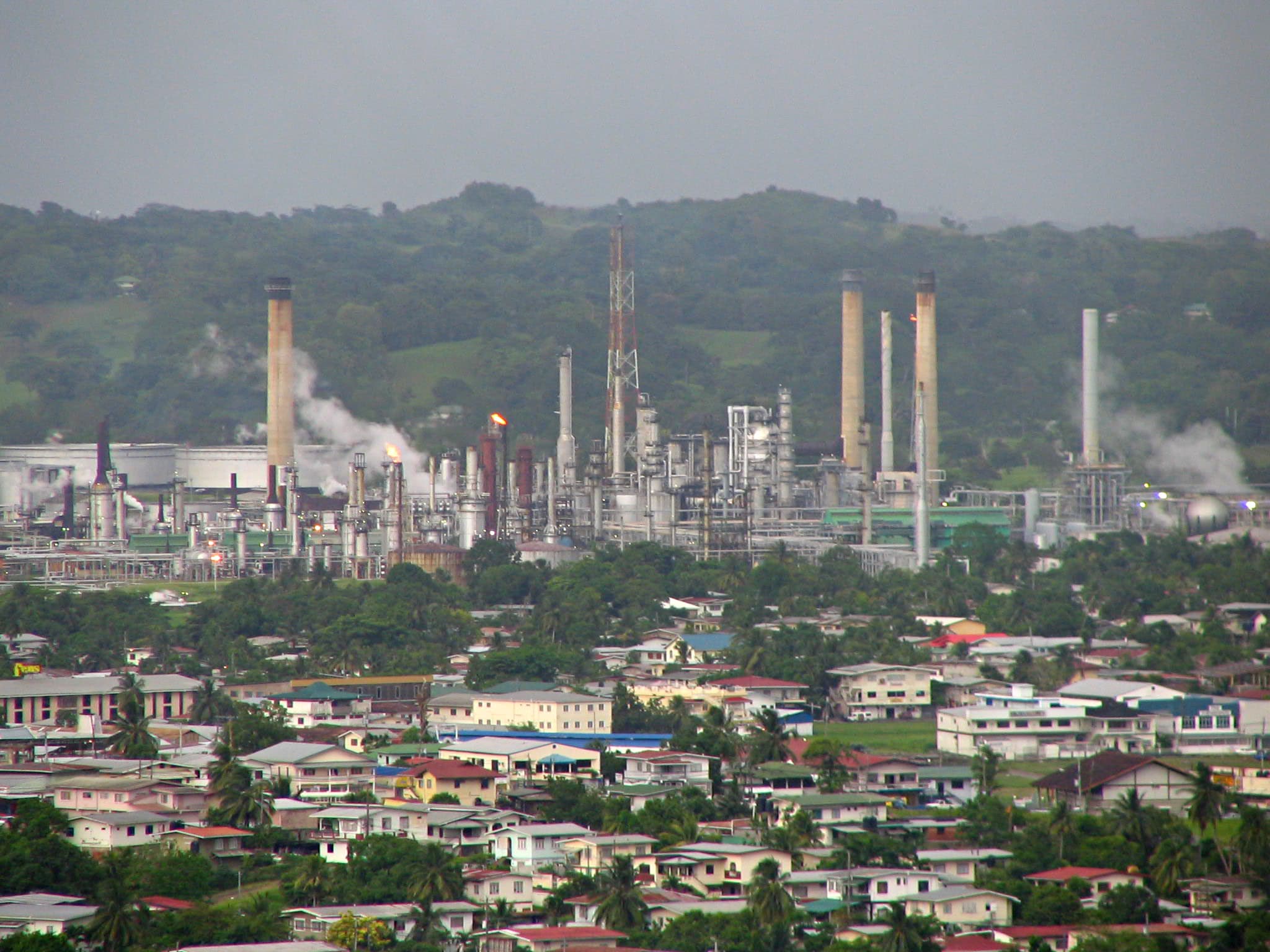
The raw figures are devastating when placed side by side. Trinidad and Tobago's crude oil production has collapsed from approximately 278,000 barrels per day at its 1970s peak to roughly 51,000 bpd by late 2025. Gas production has slid to around 2.5 billion cubic feet per day, down from a peak of 4 bcf/d in 2010. Atlantic LNG's Train 1 - the oldest of four liquefaction plants at the Point Fortin facility - is scheduled for decommissioning in the fourth quarter of 2026, not because the infrastructure has failed but because there is not enough gas to justify keeping it running. Train 3 was shut down in February for emergency repairs after a crack was discovered in its flaring system. The facility that once made Trinidad and Tobago a global LNG exporter of consequence now operates with chronic feedstock shortages.
Guyana, meanwhile, hit 926,550 barrels per day from the Stabroek Block by late February 2026 - nearly eighteen times Trinidad and Tobago's current crude output. The US$12.7 billion Uaru development, ExxonMobil's fifth project offshore Guyana, is expected to come online later this year and add another 250,000 bpd, pushing the country past 1.1 million barrels per day. A sixth project, Whiptail, follows in 2027. A seventh, Hammerhead, is sanctioned for 2029. The co-venturers - ExxonMobil (45 percent), Hess (30 percent), and CNOOC (25 percent) - have committed more than US$60 billion to develop these projects. When all eight planned developments are operating, total capacity is projected at 1.7 million bpd.
The U.S. Energy Information Administration now groups Guyana alongside Brazil and Argentina as the primary drivers of non-OPEC crude oil production growth through the end of the decade. Trinidad and Tobago does not appear in that conversation.
But the Fiscal Regimes Tell Another
Production volume is only part of the picture, and this is where Paul's argument acquires its sharpest relevance. Guyana is producing enormous quantities of oil. Whether Guyanese citizens are capturing a fair share of that wealth is a separate and far more contested question.
The 2016 Production Sharing Agreement between Guyana and the ExxonMobil-led consortium has been criticized since its terms became public. The royalty rate is 2 percent. Cost recovery is capped at 75 percent of production, meaning ExxonMobil and its partners can claim three-quarters of oil revenue to recoup their investment costs before the government sees any profit share. The remaining 25 percent is split evenly. There is no corporate income tax on the consortium's oil operations. There is no ring-fencing between projects, which means costs from one development can be offset against revenues from another. Kaieteur News has reported that what Guyana actually receives may be even less than the nominal 2 percent royalty - closer to 0.5 percent once the contractual arithmetic plays out.
The government cannot unilaterally renegotiate. Article 32 of the PSA prevents Guyana from imposing any new taxes or fees that would increase the economic burden on the contractor without written consent from ExxonMobil and its partners.
Vice President Bharrat Jagdeo has announced that a new model PSA - with improved royalty rates, ring-fencing provisions, and corporate taxation - will apply to future blocks. But the Stabroek Block, which contains the vast majority of Guyana's discovered reserves, operates under the 2016 terms. The wealth that matters most is governed by the contract that gives the least.
Trinidad and Tobago's fiscal regime was historically more favourable to the state. The supplemental petroleum tax, the petroleum profits tax, and various royalty and levy structures captured a larger share of upstream revenue for the government. But those favourable terms could not save the country from what came next: chronic underinvestment in exploration, deteriorating relationships with international operators, political interference in the state energy companies, and a downstream industrial complex at Point Lisas built on the assumption that cheap gas would flow forever.
The Nutrien shutdown at the start of 2026 - NGC cutting off gas supply in a dispute over retroactive port fees and pricing - is a direct consequence of that assumption meeting reality. When feedstock gas becomes scarce and expensive, the plants that depended on cheap supply close, and the jobs disappear, and the CO2 supply chain that served medical and food industries collapses alongside the ammonia production.
The Sovereign Wealth Question
Both countries maintain sovereign wealth funds. Neither story is particularly encouraging.
Trinidad and Tobago's Heritage and Stabilisation Fund held approximately US$6.38 billion as of February 2026. In the fiscal year ending September 2025, the government withdrew US$410 million while making zero contributions. The fund earned US$664 million in investment returns that year, meaning withdrawals consumed more than 60 percent of what the fund generated. After decades of petroleum revenue, a US$6 billion savings buffer represents a fraction of what disciplined fiscal management could have accumulated.
Guyana's Natural Resource Fund, established by the NRF Act of 2021, held approximately US$3.6 billion as of September 2025. The fund received US$2.57 billion in oil revenue during 2024 alone, and projections suggest annual inflows exceeding US$3 billion by 2026. The growth trajectory is impressive. But Guyana's fund has already drawn scrutiny: opposition figures have flagged US$2.6 billion in withdrawals, and questions persist about whether the withdrawal rules - which stipulate that only 10 percent of annual revenue can be transferred to the Consolidated Fund once earnings exceed US$5 billion per year - will hold under political pressure.
This is precisely the pattern Paul described. The money arrives. The institutions are tested. The pressure to spend now rather than save for later becomes irresistible. Trinidad and Tobago failed that test over decades. Guyana is being administered the same exam at an accelerated pace, with larger sums, and with a fiscal regime that already sends the majority of the revenue offshore before the sovereign fund question even arises.
The Pipeline That Could Rewrite the Relationship
There is one development that could reshape the economic relationship between the two countries, and it is barely discussed in Trinidad and Tobago.
Guyana is considering options to monetize its associated natural gas, including the possibility of exporting gas to Trinidad and Tobago for processing. Trinidad and Tobago has substantial spare LNG capacity - the infrastructure exists, the workforce exists, the downstream industrial knowledge exists. What does not exist is the feedstock gas to keep the system running.
At the Energy Conference 2026 in February, the T&T-Guyana cooperation was on full display. Guyanese President Irfaan Ali facilitated introductions between Energy Minister Roodal Moonilal and Arab investors, signalling that Guyana sees Trinidad and Tobago's processing infrastructure as part of its own monetization strategy. The Persad-Bissessar administration has signalled a policy shift toward engaging regional partners to fill the gap left by declining domestic production. Moonilal, however, faces a US$275 million cartel lawsuit heading to trial in June 2026 - a legal cloud over the minister responsible for negotiating the energy relationships that will determine whether the processing pivot succeeds. But Guyana is simultaneously building its own US$1.7 billion Gas-to-Energy project - a 300-megawatt power plant fed by processed Stabroek gas - expected online by mid-2026.
The strategic question is whether Trinidad and Tobago can pivot from producer to processor before Guyana builds the capacity to do everything domestically. If Guyana's Gas-to-Energy project succeeds, the incentive to pipe gas hundreds of kilometres to Trinidad diminishes considerably. The Dragon Gas field - the cross-border Venezuelan resource that was supposed to supplement Trinidad and Tobago's gas supply - remains stuck without a final investment decision, complicated by Venezuela's political dynamics and US sanctions policy.
The story of a potential Guyana-Trinidad gas pipeline has been covered almost exclusively in Guyanese media. Energy Now TT has reported on the feasibility discussions. But no sustained investigative treatment has appeared in any major Trinidad and Tobago outlet - no analysis of what it would cost, what the contractual terms might look like, what the timeline could be, or what happens to Point Lisas and Atlantic LNG if the gas never arrives.
What the Warning Actually Said
Paul's op-ed was not an attack on Trinidad and Tobago. It was a diagnostic. He wrote from inside knowledge of how institutional decay accumulates in petroleum states - how regulatory bodies become under-resourced, how licensing processes become inconsistent, how contractual opacity allows operators to extract more than they should while the state captures less than it needs.
He followed it with a second piece on March 8, focusing on Guyana's gas strategy and arguing that the fast start in oil development would mean nothing without a durable framework for gas resource management.
The irony is layered. A Trinbagonian expert publishes his analysis in Georgetown because that is where the audience is. The lessons are for Guyana's future, but they are drawn entirely from Trinidad and Tobago's past. And the country whose experience provides the cautionary tale is not having the conversation at all.
The question for Trinbagonians is not whether Guyana will repeat the same mistakes. It may or it may not. The question is what Trinidad and Tobago becomes now that the production era is ending - whether it can transition from a country that extracts wealth from the ground to one that adds value to resources flowing from elsewhere, whether its institutions can adapt to a role they were never designed for, and whether its media and political class can sustain the kind of honest assessment that Anthony Paul had to publish in another country's newspaper.
That assessment is not happening. Not in Parliament, not in the editorial pages, and not in any sustained public forum. A former Energy Ministry director had to go to Guyana to say what needed saying about Trinidad and Tobago. The applause has already faded. The question is whether anyone here noticed.
Sources
- Kaieteur News: Anthony Paul, "Before the Applause Fades: What Guyana Must Learn from Trinidad and Tobago's Oil & Gas Trajectory" (March 1, 2026)
- Kaieteur News: Anthony Paul, "Winning the Powerplay Isn't Winning the Match: The Gas Strategy Test Facing Guyana" (March 8, 2026)
- Oil & Gas Governance Network (OGGN): Republication of Paul op-ed (March 1, 2026)
- OilPrice.com: "Can Trinidad and Tobago Escape the Oil Trap?"
- Energy Now TT: "Guyana to explore feasibility of gas processing in T&T"
- U.S. Energy Information Administration: "Brazil, Guyana, and Argentina support forecast crude oil growth in 2026"
- ExxonMobil Guyana: "Daily oil production hits 900,000 barrels in Guyana's Stabroek Block" (November 2025)
- ExxonMobil: Seventh offshore development announcement (September 2025)
- Pipeline & Gas Journal: "Trinidad's Atlantic LNG Plans Q4 Decommissioning of Train 1" (January 2026)
- Trinidad Express: "$2.8b withdrawn from HSF in 2025"
- Ministry of Finance, Trinidad and Tobago: Heritage and Stabilisation Fund Quarterly Reports (2025)
- Global SWF / Bank of Guyana: Natural Resource Fund quarterly reports (2025)
- IEEFA: "ExxonMobil contract leaves Guyana exposed to financial and environmental risks"
- Kaieteur News: "Guyana only receiving 0.5% royalty instead of 2% from Exxon" (March 2024)
- Guyana Chronicle: "Regional leaders pledge stronger energy ties" (February 2026)
- Caribbean Investigative Journalism Network: "Guyana's US$1.7B Gas-to-Energy Project"
- OilNOW: Trinidad and Guyana production data (2024-2026)
- Energy Intelligence: "Trinidad Eyes Grenada, Guyana Gas as Oldest LNG Train Closes"
- IMF: Trinidad and Tobago 2026 Article IV Mission Concluding Statement (February 2026)